Category: Pricing & Estimates

Guides and tools to help cleaning business owners price their jobs and write professional estimates.

  • How to Raise Prices on Cleaning Clients (+ Email Template)

    How to Raise Prices on Cleaning Clients (+ Email Template)

    Raising your prices is one of the most uncomfortable parts of running a cleaning business. You worry that clients will be upset, that they’ll leave, or that you’ll look greedy. So many cleaners put it off for years, while their costs for gas, supplies and insurance keep going up.

    The truth is that regular, well-communicated price increases are normal in any service business, and most good clients understand them. This guide explains when to raise your prices, how much to raise them and how to tell your clients, with an email template you can copy.

    Signs it’s time to raise your prices

    • Your costs have gone up. Supplies, gas, insurance or wages cost more than when you set your prices.
    • You’re booked solid. If your schedule is full and you’re turning down new clients, your prices are probably too low.
    • You haven’t raised prices in over a year. Even small yearly increases keep your income in line with rising costs.
    • Jobs take longer than you charge for. If a client’s home always takes more time than your quote assumed, the price needs updating.
    • You’re charging less than local competitors for the same quality of work.

    How much should you raise your prices?

    There’s no single right number, but a few principles help:

    • Small, regular increases are easier to accept than big, rare ones. A modest increase every year is far less of a shock than a large jump after three years of the same price.
    • Base it on your numbers. Look at how much your costs have increased, and how long each client’s job really takes.
    • Treat new and existing clients differently. You can raise prices for new clients immediately and give existing clients advance notice.
    • Review clients one by one. A client whose home always takes an extra hour may need a bigger adjustment than one whose job matches your original estimate.

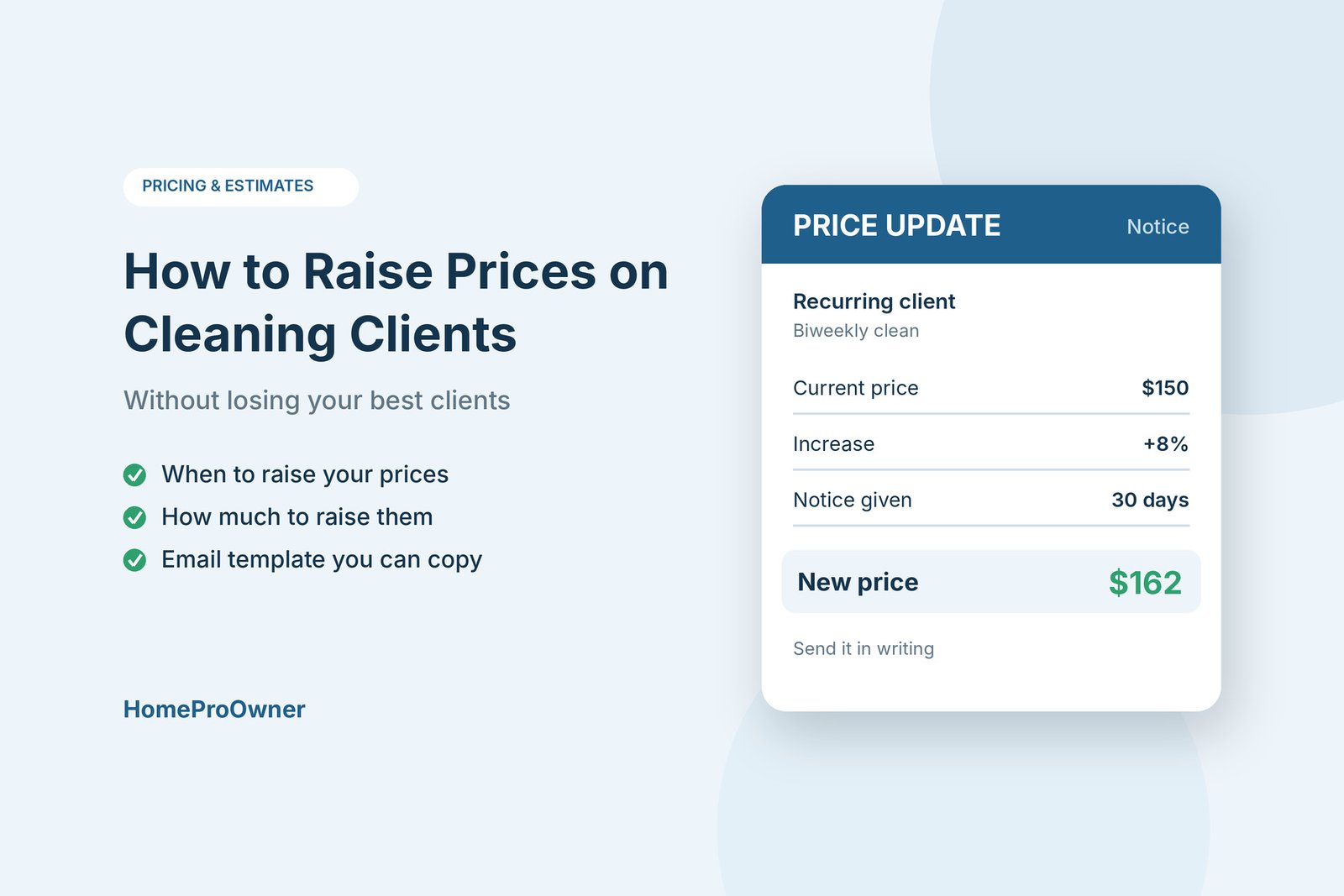
    For example, a recurring biweekly client paying $150 per clean with an 8% increase would pay $162 per clean. That small change adds up to over $300 a year from a single client.

    How to tell your clients

    1. Give advance notice. Tell clients at least 30 days before the new price takes effect. Surprises are what make clients angry, not reasonable increases.

    2. Put it in writing. Send an email or a letter, so there’s no confusion about the new price or the date.

    3. Keep it short and confident. Explain briefly, thank them, and state the new price and date. Don’t over-apologize or justify every dollar.

    4. Focus on the value you provide. Remind them of what they get: reliability, quality, trusted people in their home.

    5. Be ready for questions. Most clients will simply accept. If someone pushes back, you can offer a smaller scope or a different frequency, rather than cancelling the increase.

    Email template you can copy

    Subject: Update to your cleaning service rate

    Hi [Client name],

    Thank you for trusting [Business name] with your home. It’s been a pleasure working with you.

    I’m writing to let you know that starting on [date], your rate for [weekly/biweekly] cleaning will change from $[current price] to $[new price] per visit. This change reflects the rising cost of supplies, transportation and insurance, and allows us to keep providing the same reliable, high-quality service you’re used to.

    Your service, schedule and team will stay exactly the same. If you have any questions, I’m happy to talk.

    Thank you again for being a valued client.

    Best regards,
    [Your name]
    [Business name] · [Phone]

    What if a client leaves?

    It can happen, and it’s not always a bad thing. If a client leaves over a reasonable increase, their spot in your schedule can go to a new client at your current rate. Our guide on how to get your first cleaning clients explains how to keep your schedule full.

    Common mistakes to avoid

    • Waiting too long. Years without an increase make the eventual jump much bigger and harder to accept.
    • Raising prices without notice. Always give clients time to prepare.
    • Apologizing too much. It makes the increase sound unjustified.
    • Raising prices at the same time as a drop in quality. Make sure your service is consistent before you ask clients to pay more.
    • Forgetting new clients. Update your price list and estimates for new clients right away.

    Frequently asked questions

    How often should I raise my cleaning prices?
    Many cleaning businesses review their prices once a year. Small, regular increases are easier for clients to accept than large, rare ones.

    How much notice should I give clients before raising prices?
    At least 30 days is a good standard. It gives clients time to plan and shows respect for the relationship.

    Should I raise prices for all clients at once?
    Not necessarily. You can apply new prices to new clients immediately and update existing clients on a set date, reviewing each one based on how long their job really takes.

    Will I lose clients if I raise my prices?
    You might lose a few, but most good clients accept reasonable, well-communicated increases. The new rate also means you need fewer clients to earn the same income.
  • How to Price Post-Construction Cleaning (2026 Rates + Example)

    How to Price Post-Construction Cleaning (2026 Rates + Example)

    Post-construction cleaning is one of the best-paid jobs in the cleaning business, and one of the easiest to get wrong. Construction dust gets everywhere, the work often happens in several visits, and the condition of the site can be very different from what the contractor described on the phone.

    This guide explains the phases of a post-construction clean, what businesses charge in the U.S., and a simple method to price these jobs, with a worked example.

    The three phases of post-construction cleaning

    Post-construction cleaning usually isn’t one job. It’s often split into phases, and each one should be priced separately:

    • Rough clean: done while construction is still finishing. It removes debris and most of the construction dust from floors, walls and surfaces. It’s not the final clean.
    • Final clean: done once the work is finished. It removes the last dust, fingerprints and stickers, wipes every surface, cleans vents, vacuums floors and, if agreed, cleans windows. This is the clean that makes the space ready to live in.
    • Touch-up clean: a short return visit to remove dust that settled after the final clean, usually on countertops, window sills, vents and some floors.

    Some jobs also include exterior cleaning, such as outside windows, debris removal or pressure washing. Always ask which phases the client needs before quoting.

    How much to charge for post-construction cleaning

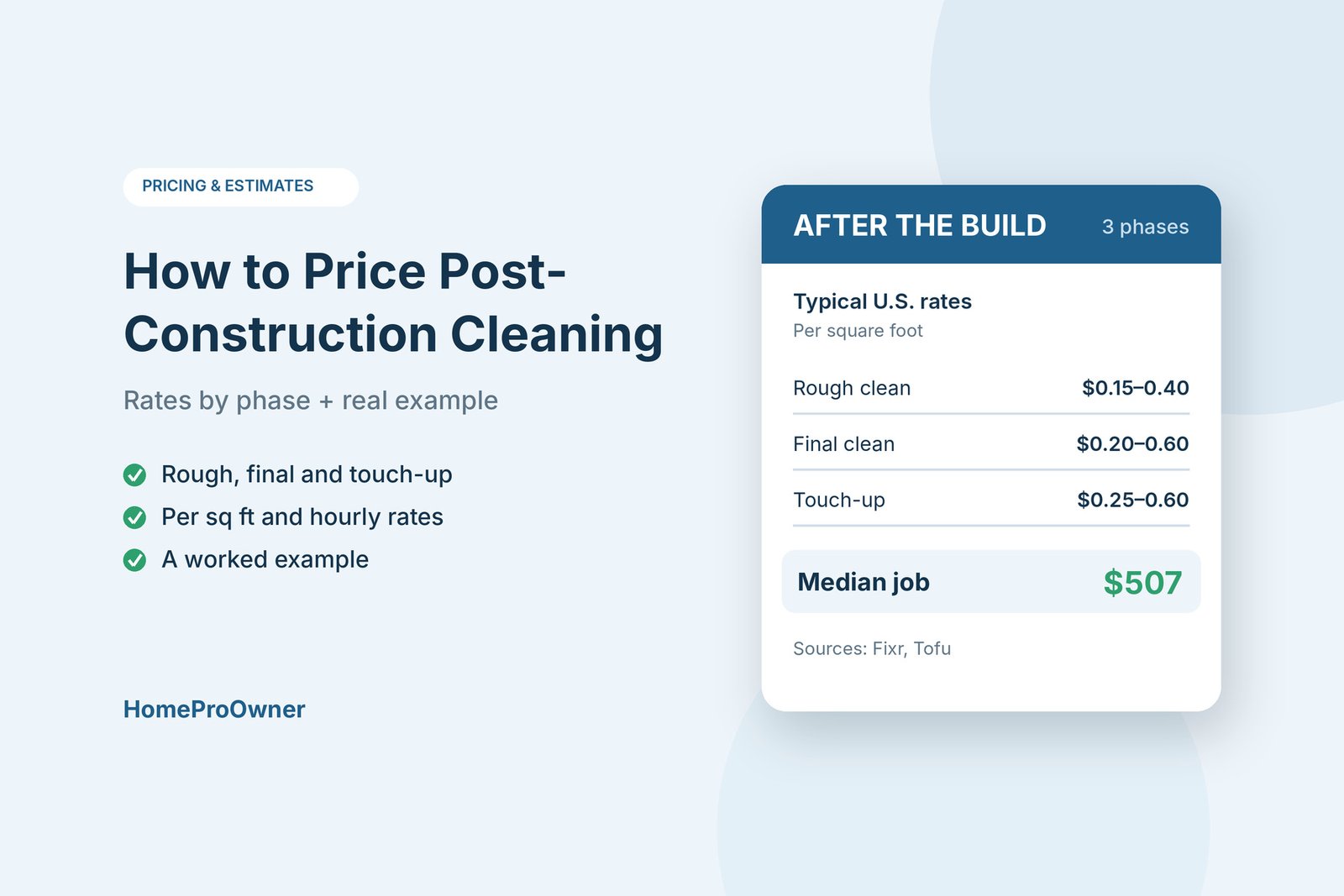
    Here are typical U.S. rates per square foot by phase, according to Fixr (2025 data):

    PhaseTypical rate per sq ft
    Rough clean$0.15–$0.40
    Final clean$0.20–$0.60
    Touch-up clean$0.25–$0.60
    Exterior clean$0.29–$0.60

    Fixr also reports hourly rates of around $30 to $50 per worker, and notes that many projects have a minimum of 8 hours with 2 workers. Real invoice data from Tofu shows a median of $507 for post-construction cleans, with most jobs between $323 and $1,034.

    The range is wide because no two sites are the same. A small renovated bathroom and a brand-new 3,000 sq ft house are completely different jobs.

    New construction vs. post-renovation cleaning prices

    Not every construction clean up is the same job, and the price should reflect that.

    New construction cleaning is usually the bigger job. Every surface in the building is covered in fine dust, there are stickers on windows and appliances, paint and caulk marks on floors, and often a lot of debris left behind. New builds also tend to be larger and need every window, cabinet and fixture cleaned for the first time. According to Fixr, the high end of the market, around $2,400, is a new construction clean that includes complete cleaning, junk removal, exterior work and spot cleaning.

    Post-renovation cleaning usually covers a smaller area, like a remodeled kitchen or bathroom, but it comes with its own challenges. People often live in the home, so you have to work around furniture and belongings, and dust from the renovated room usually spreads to the rest of the house. Fixr puts the low end of the market, around $275, at a rough clean of a renovated apartment.

    When you quote, ask which one it is, and always ask how far the dust has spread beyond the work area. A small bathroom remodel can still mean dusting the whole house.

    How to price a post-construction job, step by step

    1. Visit the site before quoting. This is not optional for post-construction work. Photos rarely show how much dust is really there, and you need to see the debris, the finishes and the number of windows.

    2. Agree on the scope with the contractor or owner. Which phases? Is debris removal included, or will the contractor clear it? Are windows included, inside and out? Who removes stickers and paint splatters?

    3. Estimate the hours. Construction dust takes longer than normal dirt. A useful starting point is that one cleaner covers around 250 square feet per hour on a final clean, compared with about 500 on a standard house clean. Add time for bathrooms, windows and heavy dust.

    4. Price each phase separately. Multiply hours by your hourly rate for each phase, then add extras like interior windows. Pricing by phase protects you: if the client skips the rough clean, your final clean will take longer, and the quote should reflect it.

    5. Check your price against the market. Divide your total by the square footage. If you’re outside the typical range, review your time estimate.

    6. Plan your equipment. Construction dust needs the right tools: a vacuum with a HEPA filter, microfiber cloths, scrapers for stickers and paint, and protective masks. Factor the wear on your equipment into your rate.

    7. Write clear terms. State that the site must be free of workers and large debris when you arrive, and that extra visits caused by new construction work will be charged separately.

    A worked example

    A contractor has just finished remodeling a 2,000 sq ft house with 2 bathrooms. They’ve cleared the large debris and need a final clean, plus a touch-up visit before the owners move in. The house has 15 interior windows.

    ItemPrice
    Final clean (8.6 cleaner-hours at $50/hour)$430
    Interior windows (15 windows at $6 each)$90
    Touch-up visit (2 cleaner-hours at $50/hour)$100
    Total$620

    That works out to about $0.31 per square foot, within the typical range for a final clean. With a team of two, the final clean takes a little over 4 hours on site. You can reproduce the final clean estimate with our free cleaning estimate calculator by selecting “Post-construction clean”.

    Where to find post-construction jobs

    The best source is contractors and remodelers, because they finish projects every month and need a cleaner they can trust. Real estate agents selling new builds and property managers renovating units are also good partners. Our guide on how to get your first cleaning clients explains how to approach local partners.

    Common mistakes to avoid

    • Quoting without visiting the site. Construction dust is impossible to judge from photos.
    • Pricing it like a deep clean. Fine dust settles again and again, and takes much longer to remove.
    • Not defining the phases. If you quote a “final clean” and arrive to a rough-clean situation, you’ll lose money.
    • Starting while workers are still on site. New dust will undo your work.
    • Forgetting the touch-up visit. Dust keeps settling for days; plan and price a return visit.

    Frequently asked questions

    How much does construction clean up cost?
    Fixr reports a national average of about $650 for post-construction cleaning, with most jobs between $500 and $800. Real invoice data from Tofu shows a median of $507. Large new builds with junk removal and exterior work can cost much more.

    What’s the difference between new construction and post-renovation cleaning?
    New construction cleaning covers an entire new building, with dust, stickers and debris everywhere. Post-renovation cleaning usually covers part of a home that people still live in, so it’s smaller but requires more care around furniture and belongings.

    How much does post-construction cleaning cost per square foot?
    Typically between $0.15 and $0.60 per square foot, depending on the phase and the condition of the site. Final cleans usually fall between $0.20 and $0.60.

    How long does a post-construction clean take?
    It depends on size and dust levels. As a rough guide, one cleaner covers around 250 square feet per hour on a final clean, so a 2,000 sq ft home takes about 8 to 9 cleaner-hours.

    Should I charge by the hour or by the square foot?
    Estimate the hours to calculate your price, then present it as a fixed price per phase. Clients get a clear number, and you’re protected because it’s based on real time.

    Do I need special equipment for post-construction cleaning?
    A HEPA-filter vacuum is the most important tool, because regular vacuums spread fine construction dust back into the air. Add scrapers, plenty of microfiber cloths and protective masks.

  • Airbnb Cleaning Rates: How Much to Charge Hosts in 2026

    Airbnb Cleaning Rates: How Much to Charge Hosts in 2026

    Airbnb and other short-term rentals are some of the best clients a cleaning business can have. Hosts need a cleaner after every single guest, they book work regularly, and they care more about reliability than about getting the lowest price. But turnover cleans work differently from regular house cleaning, and pricing them like a normal clean is one of the most common mistakes.

    This guide explains what to charge for Airbnb cleaning in 2026, what a turnover clean should include, and which extras you should charge for separately.

    Cleaner rates vs. the guest cleaning fee

    First, an important difference. On Airbnb, hosts usually charge guests a cleaning fee when they book. That’s the host’s price to the guest. What matters to you is your rate per turnover: what you charge the host for cleaning between guests.

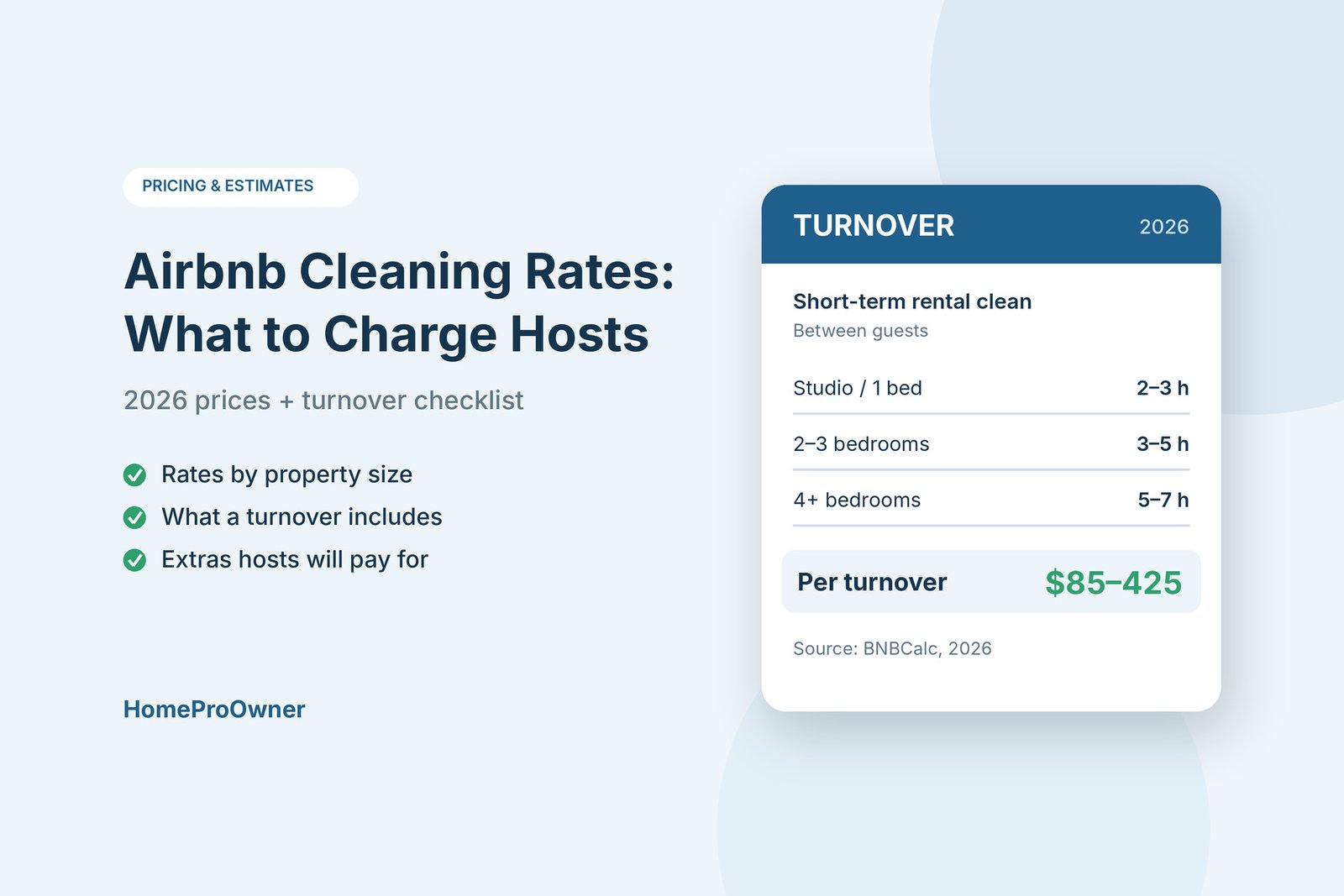
    The two are related, because hosts use the guest fee to cover your cost. According to BNBCalc, cleaners typically charge hosts between $85 and $160 per turnover for a studio, and between $210 and $425 for a large home, depending on location and service level. Knowing what guests pay in your area helps you understand how much room a host has in their budget.

    How much to charge per turnover

    Most turnover cleaners charge a flat rate per turnover, based on the size of the property. It’s simple for hosts to budget, and once you know the property, you know exactly how long it takes.

    To set your flat rates, start with the time each property takes. BNBCalc estimates that a studio takes around 2 to 3 hours and a home with 4 or more bedrooms around 5 to 7 hours. Here’s how that translates into prices at an example rate of $45 per hour:

    Property sizeEstimated timePrice at $45/hour
    Studio or 1 bedroom2–3 hours$90–$135
    2 bedrooms3–4 hours$135–$180
    3 bedrooms4–5 hours$180–$225
    4+ bedrooms5–7 hours$225–$315

    The times for 2- and 3-bedroom properties are our own estimates between BNBCalc’s figures. Your real times will depend on the property, the number of bathrooms and how guests leave it. Time your first few turnovers at each property and adjust.

    What a turnover clean should include

    A turnover is more than a cleaning job: the property has to be ready for the next guest to walk in and feel like they’re the first. A standard turnover usually includes:

    • Beds: strip all beds and make them with fresh linens.
    • Bathrooms: clean and disinfect toilets, showers, sinks and mirrors, and replace towels.
    • Kitchen: clean counters, sink, stovetop, microwave and appliance exteriors; load or empty the dishwasher; check the fridge for leftovers.
    • Floors: vacuum and mop all rooms.
    • Trash: empty every bin and take the trash out.
    • Staging: arrange towels, pillows and amenities the way the host wants them for listing photos.
    • Inspection: check for damage, missing items or anything broken, and report it to the host with photos.

    Agree on a written checklist with each host. Many hosts have specific standards (like folding towels a certain way), and a shared checklist avoids disputes and bad reviews.

    Extras you should charge for

    Turnovers often involve tasks beyond cleaning. Price these separately so your base rate stays competitive:

    • Laundry: washing and drying linens and towels, especially if you take them off-site. This can add hours to every turnover.
    • Restocking: refilling toilet paper, soap, coffee and other supplies. BNBCalc estimates supplies cost hosts around $10 to $28 per turnover; agree on whether the host provides them or you buy them and charge them back.
    • Same-day turnovers: when a guest checks out at 11 a.m. and the next one arrives at 3 or 4 p.m., you’re working against the clock. Many cleaners charge more for tight windows.
    • Periodic deep cleans: every few months, the property needs a deeper clean (inside appliances, baseboards, windows). Price it like any deep clean. Our guide on how to price a deep cleaning job explains how.
    • Extra amenities: hot tubs, grills, balconies or outdoor furniture.

    An example

    A host has a 2-bedroom, 2-bathroom apartment with frequent bookings. The turnover takes you about 3.5 hours, and the host wants you to handle laundry and restocking.

    ItemPrice
    Turnover clean (3.5 hours at $45/hour)$157.50
    Laundry (linens and towels, done on-site)$25
    Restocking (host provides supplies)$10
    Total per turnover$192.50

    If the property has 8 turnovers a month, that’s around $1,540 a month from a single client. That’s why Airbnb hosts are worth winning, and worth keeping.

    Why reliability matters more than price

    For a host, a late or missed clean can mean a bad review, a refund, or a cancelled booking. That’s why many hosts will happily pay more for a cleaner they can count on. To stand out:

    • Confirm every turnover the day before.
    • Send photos when you finish.
    • Report damage and low supplies right away.
    • Have a backup plan if you’re sick.

    If you’re looking for your first hosts, our guide on how to get your first cleaning clients includes tips on partnering with local hosts.

    Common mistakes to avoid

    • Pricing turnovers like a regular clean and forgetting laundry, staging and inspection time.
    • Including laundry for free. It’s often the most time-consuming part.
    • Not timing each property. Two 2-bedroom apartments can take very different times.
    • Skipping the checklist. Without one, the host’s expectations and yours will eventually clash.
    • Not charging for last-minute jobs. Same-day or emergency requests deserve a premium.

    Frequently asked questions

    Should I charge Airbnb hosts by the hour or a flat rate?
    A flat rate per turnover is the most common, because hosts can plan their costs. Base it on the time each property really takes, and review it if the work changes.

    How long does an Airbnb turnover take?
    It depends on size and condition. As a rough guide, a studio takes around 2 to 3 hours and a home with 4 or more bedrooms around 5 to 7 hours.

    Who pays for cleaning supplies and amenities?
    It depends on your agreement. Some hosts provide everything; others prefer that you restock and add the cost to your invoice. Put it in writing either way.

    Is Airbnb cleaning more profitable than regular house cleaning?
    It can be, because hosts book frequently and value reliability. The trade-off is tighter schedules and less flexibility, so price the extra pressure into your rates.

  • How to Price a Deep Cleaning Job (2026 Rates + Real Examples)

    How to Price a Deep Cleaning Job (2026 Rates + Real Examples)

    Deep cleans are some of the most profitable jobs a cleaning business can take on, and some of the easiest to underprice. They take longer than you expect, the condition of the home is hard to judge from a phone call, and every source online seems to give a different number for how much more you should charge.

    This guide shows you what a deep clean should include, what cleaning businesses actually charge in 2026, and a simple method to price any deep clean, with two worked examples.

    What counts as a deep clean?

    A deep clean covers everything in a standard clean, plus the areas that build up dirt over months. Being clear about the difference is the first step to pricing it right, because if the client thinks “deep clean” means “a slightly longer regular clean,” you’ll end up doing far more work than you charged for.

    TaskStandard cleanDeep clean
    Dust surfaces, vacuum and mop floors✓✓
    Clean kitchen counters, sink and stovetop✓✓
    Clean toilets, showers, tubs and sinks✓✓
    Baseboards, door frames and light switches✓
    Ceiling fans, light fixtures and vents✓
    Scrub grout and remove soap scum and limescale✓
    Degrease kitchen cabinet fronts and backsplash✓
    Clean behind and under furniture and appliances✓
    Window sills and tracks✓
    Inside oven, fridge or cabinetsUsually an add-on

    Write this list into your estimate. It sets expectations and protects you if a client later asks why the inside of the oven wasn’t cleaned.

    How much to charge for a deep clean in 2026

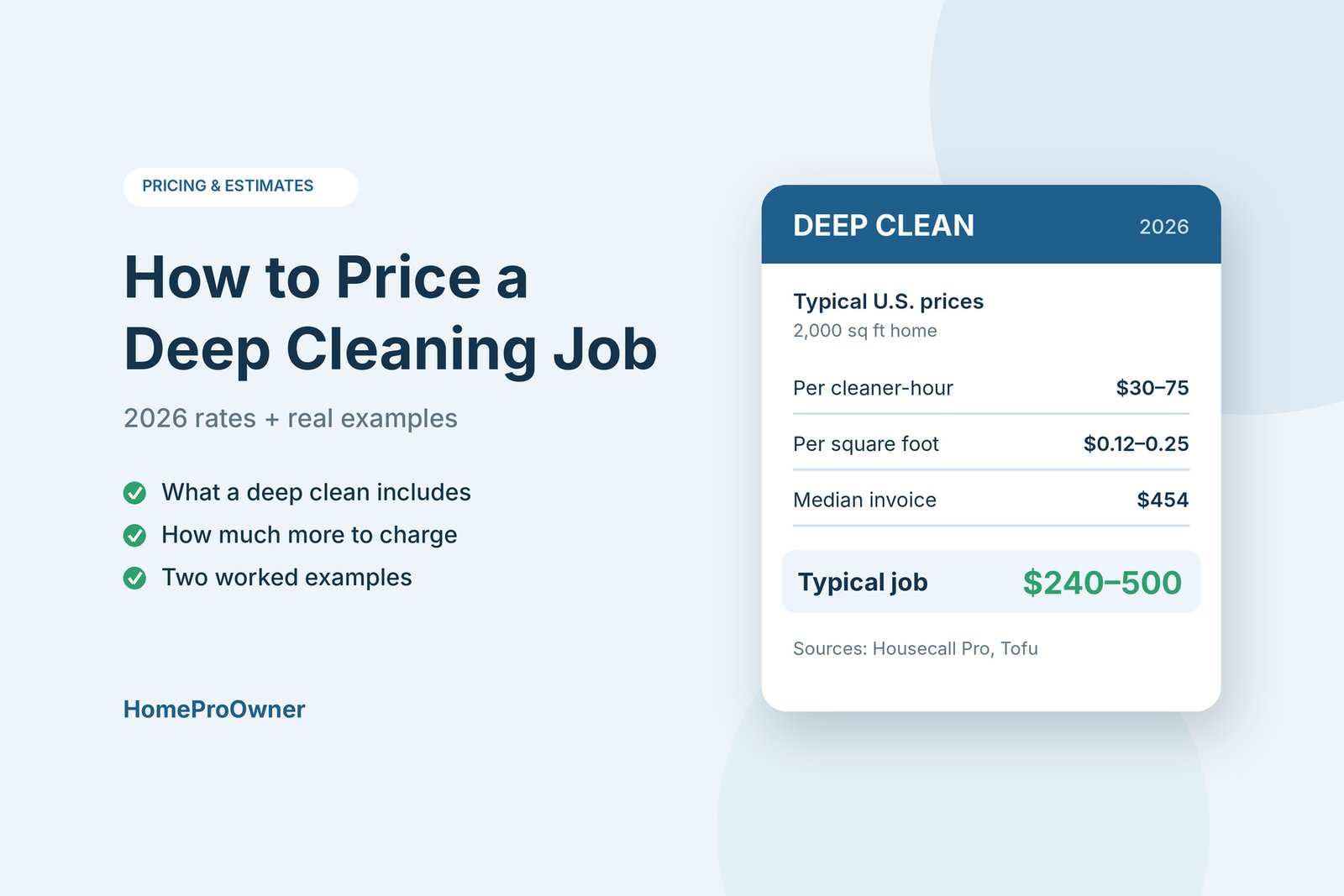
    Here are typical U.S. deep cleaning prices, based on Housecall Pro’s 2026 pricing guide:

    Home sizeTypical deep clean price
    1,000 sq ft or less$120–$250
    2,000 sq ft$240–$500
    3,000 sq ft$360–$750

    By other pricing methods, deep cleans typically run $30–$75 per cleaner-hour, or $0.12–$0.25 per square foot. Real invoice data points in the same direction: an analysis by Tofu of more than 24,000 deep cleaning invoices found a median of $454, with most jobs falling between $304 and $722.

    These ranges are wide on purpose. Your local market, your costs, and above all the condition of the home will decide where you land.

    How much more should a deep clean cost than a regular clean?

    This is where things get confusing, because the most-cited sources disagree:

    • Housecall Pro says deep cleaning typically costs 50% to 100% more than a standard clean.
    • InvoiceFly recommends adding 30% to 50% to your normal rates.
    • Tofu’s invoice data shows that, in practice, deep cleans end up only about 15% to 20% more expensive than regular cleans.

    So who’s right? In a way, all of them, because they’re measuring different things. Percentage rules of thumb describe how much extra work a deep clean usually involves. Invoice data reflects what businesses actually manage to charge, and many of them, especially new ones, charge too little for deep cleans and absorb the extra hours themselves.

    The safest approach is not to pick a percentage at all. Instead, estimate the real time the job will take and charge your normal hourly rate for every hour. A lightly used home might only need 20% more time than a regular clean. A home that hasn’t been cleaned properly in a year can easily need double. Pricing by time, not by percentage, covers both.

    How to price a deep clean, step by step

    1. Ask the right questions before you quote. When was the home last professionally cleaned? Are there pets? Any areas with heavy buildup, like the oven, the shower or the kitchen cabinets? Is the home furnished, and how cluttered is it? Ask for a few photos of the kitchen and bathrooms. They tell you more than any description.

    2. Rate the condition. Put the home into one of three groups: light (well maintained), average, or heavy (months of buildup, pet hair, grease). This single judgment moves the price more than anything else.

    3. Estimate the cleaner-hours. A useful starting point is that one cleaner covers around 300 square feet per hour on a deep clean, compared with about 500 on a standard clean. Add time for each extra bathroom, then adjust for condition and pets. Over time, replace these numbers with your own data from past jobs.

    4. Multiply by your hourly rate. Use the same rate you use for every other job. The deep clean pays more because it takes more hours, not because you charge more per hour.

    5. Price extras separately. Inside the oven, inside the fridge, inside cabinets and interior windows should be line items, not “included.” It keeps your base price competitive and lets the client choose.

    6. Check the result against the market. Divide your total by the square footage. If you’re well below $0.12 or well above $0.25 per square foot, double-check your time estimate. Being above the range can be perfectly fine for a heavy job, as long as you can explain why.

    7. Protect yourself with clear terms. State in your estimate that the price is based on the photos and information provided, and that it may be adjusted if the condition is significantly different on arrival.

    Two real examples

    Both examples use a rate of $50 per cleaner-hour. You can reproduce them with our free cleaning estimate calculator.

    Example 1: a well-kept apartment
    1,200 sq ft, 2 bedrooms, 1 bathroom, average condition, no pets. The client wants the fridge cleaned inside.

    ItemPrice
    Deep clean, all rooms (4 cleaner-hours at $50/hour)$200
    Inside fridge$35
    Total$235

    That works out to about $0.20 per square foot, right in the middle of the typical range.

    Example 2: a family home with heavy buildup
    2,500 sq ft, 4 bedrooms, 3 bathrooms, heavy buildup, two dogs. The client wants the oven and fridge cleaned inside.

    ItemPrice
    Deep clean, all rooms (about 13.6 cleaner-hours at $50/hour)$680
    Inside oven$35
    Inside fridge$35
    Total$750

    That’s about $0.30 per square foot, above the usual range. But it’s justified: heavy buildup and pet hair add almost 45% to the time. With a team of two cleaners, it’s roughly a 7-hour job on site. If you had priced this home at a flat “regular price plus 20%,” you would have lost several hours of paid work.

    Use the deep clean to win a recurring client

    A deep clean is often the first job you do for a new client, and it’s the perfect moment to offer recurring service. Once the home has been reset, regular visits are much faster.

    For the home in Example 2, a biweekly standard clean after the deep clean would take around 6.4 cleaner-hours, or about $320 per visit. The client sees a clear reason to keep you, and you get predictable income from a home you already know.

    Common mistakes when pricing deep cleans

    • Quoting a deep clean like a regular clean with a small markup. Price the hours, not a percentage.
    • Quoting without photos or a walkthrough. Condition is the biggest variable, and you can’t judge it over the phone.
    • Including every extra for free. Ovens, fridges and cabinets can each add 30 to 60 minutes.
    • Forgetting the team size. Two cleaners finish faster, but the client still pays for every cleaner-hour.
    • Not writing down what’s included. A clear checklist prevents disputes.

    Frequently asked questions

    How long does a deep clean take?
    It depends on size and condition. As a rough guide, one cleaner covers around 300 square feet per hour, so a 2,000 sq ft home in average condition takes about 7 to 8 cleaner-hours, or 3.5 to 4 hours on site with a team of two.

    Should I charge a flat rate or by the hour for deep cleans?
    For first-time deep cleans, base your price on estimated hours, then present it to the client as a fixed price. Clients prefer knowing the total in advance, and you’re protected because the estimate came from real time.

    Should the first clean for a new client always be a deep clean?
    In most cases, yes. If the home hasn’t been professionally cleaned in a while, a standard clean won’t bring it to the level you’ll be maintaining, and the client will judge you on the result.

    Do I need to charge more for move-out deep cleans?
    Usually yes. Move-out cleans tend to include inside cabinets and appliances, and landlords expect a higher standard. Price them as a deep clean with those extras included.

  • How to Write a Cleaning Estimate (Step-by-Step + Free Calculator)

    How to Write a Cleaning Estimate (Step-by-Step + Free Calculator)

    A good cleaning estimate does two jobs at once: it tells the client exactly what they’re paying for, and it protects you from doing three hours of extra work for free. Get it wrong and you either lose the job because your price looks random, or win it and lose money on it.

    In this guide, you’ll learn what to include in a cleaning estimate, how to calculate a fair price, and how to put it all together, with a real example and a free calculator you can use right now.

    What to include in a cleaning estimate

    Every cleaning estimate should answer the client’s questions before they ask them. At a minimum, include:

    • Your business details: name, phone, email, and logo if you have one.
    • Client details: name, address of the property, and contact information.
    • Date and estimate number: so you can track it and refer back to it.
    • Type of cleaning: standard, deep, move-out, or post-construction.
    • Scope of work: a clear list of rooms and tasks included.
    • Extras: anything outside the standard scope, like the inside of the fridge or oven, priced separately.
    • Total price: with a breakdown, not just one number.
    • Terms: payment method, cancellation policy, and what happens if the home is in worse condition than expected.
    • Expiration date: most estimates are valid for 14 to 30 days.

    The scope of work is the most important part. “Clean the kitchen” can mean wiping counters or degreasing every cabinet. Spell it out.

    How to calculate the price

    There are three common ways to price a cleaning job, and most successful businesses use more than one.

    Hourly pricing. You estimate how many cleaner-hours the job takes and multiply by your hourly rate. In the U.S., most cleaning businesses charge between $30 and $75 per cleaner per hour in 2026, according to Housecall Pro’s 2026 pricing guide. Hourly pricing works well for first visits and homes you’ve never seen.

    Per-square-foot pricing. You charge a rate based on the home’s size, usually somewhere between $0.10 and $0.35 per square foot depending on the type of cleaning. It’s simple and works well for large or empty homes, but it ignores clutter and condition, so always pair it with a walkthrough.

    Flat-rate pricing. You charge a fixed price per visit. Clients love it because they know the number in advance. The smart move is to start with hourly or square-foot pricing for the first visit, then switch recurring clients to a flat rate once you know how long the job really takes.

    What makes the price go up or down:

    • Size of the home and number of bathrooms (bathrooms take the most time).
    • Condition: a home with months of buildup can take 30% longer or more.
    • Pets: pet hair adds time to every room.
    • Type of clean: deep cleans typically cost 50% to 100% more than standard cleans.
    • Frequency: weekly and biweekly clients usually get a lower per-visit price, because the home stays cleaner.

    For reference, an analysis of more than 214,000 real cleaning invoices by Tofu found a median price of $385 for a residential cleaning job in 2026, $454 for a deep clean, and $347 for a move-out clean. Your local market may be higher or lower, but these numbers are a useful reality check.

    One small business owner I work with told me his biggest mistake early on wasn’t the number itself. It was overcomplicating the price, both when he calculated it and when he talked about it with clients. Looking back, he realized the problem was that he didn’t truly see the value of what he was offering, so he hesitated, over-explained, and second-guessed every quote. That pushed him to rethink his value proposition. Since then, he follows a simple rule: whenever a price feels “too high” to him, he takes it as a sign that he’s undervaluing his work, and he adds 10%.

    Try it: cleaning estimate calculator

    Use the calculator below to get a starting price for any job. Change the hourly rate to match your area and your costs.

    Cleaning Estimate Calculator

    Enter the job details to get a starting price range for your estimate. Adjust the hourly rate to match your local market.

    Extras
    Suggested estimate
    $0
    Estimated labor0 cleaner-hours
    Time on site0 h
    Labor cost$0
    Extras$0
    Effective price per sq ft$0.00

    This calculator gives a starting point, not a final quote. Real prices depend on your area, your costs and what you see during the walkthrough. Always confirm the scope with the client before sending the estimate.

    Step-by-step: how to write the estimate

    1. Ask the right questions first. Before you price anything, find out the size of the home, the number of bedrooms and bathrooms, whether there are pets, when it was last professionally cleaned, and what the client cares about most.

    2. Do a walkthrough when you can. A quick visit or video call shows you things the client won’t mention: clutter, stains, buildup, or a kitchen that hasn’t been degreased in years. For first-time deep cleans and move-outs, a walkthrough is almost always worth it.

    3. Estimate the time. Use your own past jobs if you have them. If you’re new, a rough starting point is that one cleaner covers around 500 square feet per hour on a standard clean, and closer to 300 on a deep clean. Then adjust for bathrooms, condition, and pets.

    4. Calculate the price. Multiply cleaner-hours by your hourly rate, then add extras. Check the result against the per-square-foot range to make sure it isn’t way off.

    5. Write the scope clearly. List every room and task. Add a line for what is not included, like inside the oven or exterior windows. This one line prevents most disagreements.

    6. Add your terms and send it fast. Include payment terms, your cancellation policy, and an expiration date. Send it the same day if you can; the first professional estimate a client receives often wins the job.

    7. Follow up. If you don’t hear back in two or three days, send a short, friendly message. Many clients simply forget.

    Example cleaning estimate

    Here’s what a real estimate might look like for a first-time deep clean:

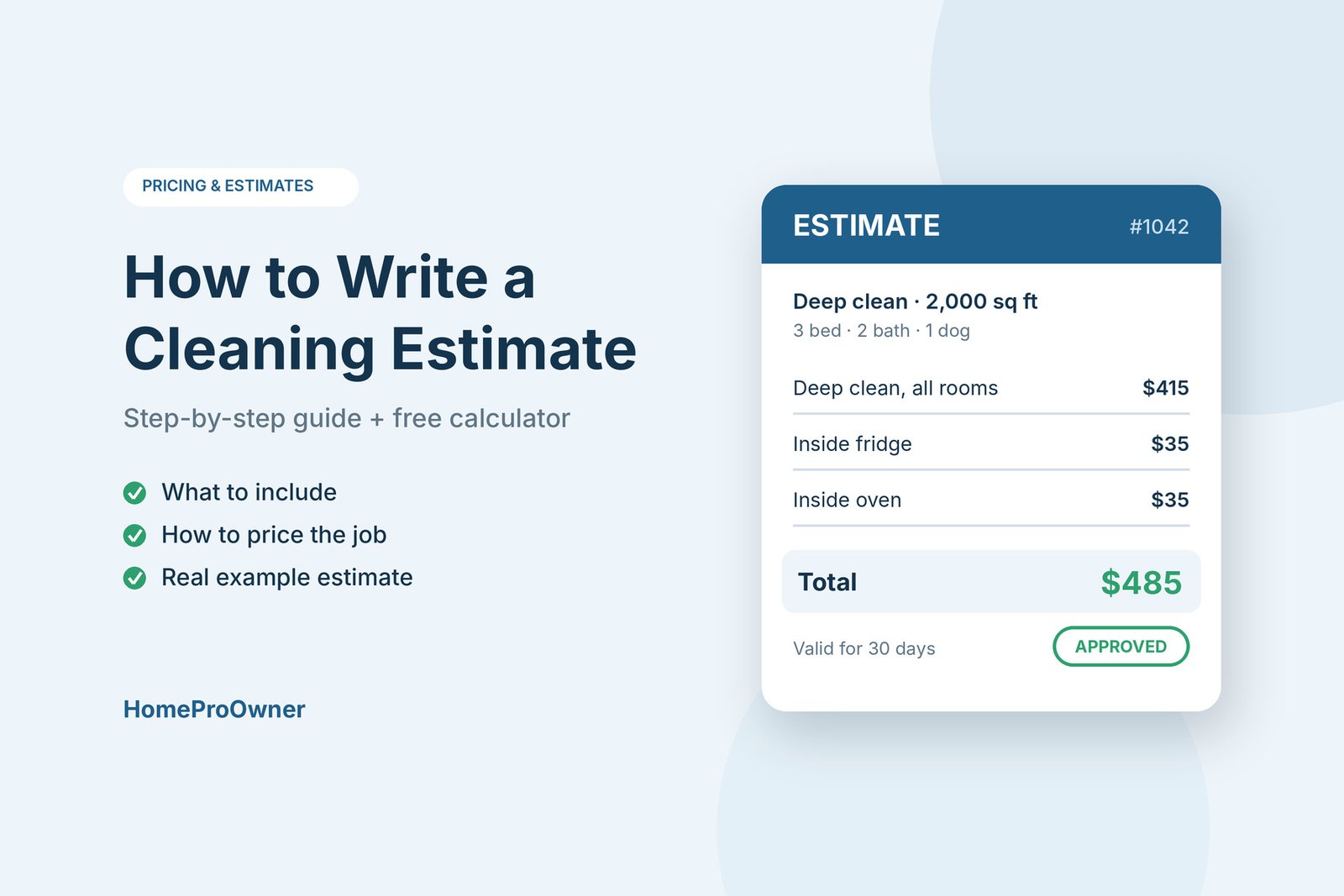
    Client: Sarah Johnson, 2,000 sq ft home, 3 bedrooms, 2 bathrooms, one dog
    Type of cleaning: Deep clean (first visit)

    ItemPrice
    Deep clean, all rooms (8.3 cleaner-hours at $50/hour)$415
    Inside fridge$35
    Inside oven$35
    Total$485

    Included: dusting all reachable surfaces, baseboards, ceiling fans and light fixtures, kitchen cabinets wiped outside, appliances cleaned outside, bathrooms fully scrubbed and descaled, floors vacuumed and mopped, trash removed.
    Not included: exterior windows, carpet shampooing, inside cabinets.
    Terms: payment due on completion by card or bank transfer. Cancellations with less than 24 hours’ notice are charged 50%. If the home’s condition is significantly different from what was described, the price may be adjusted before work begins.
    Valid until: 30 days from the estimate date.

    Free cleaning estimate template

    Want to skip the blank page? Download this free one-page template with everything covered in this guide: client details, job details, scope of work, pricing table, terms, and a signature section. Just replace the text in brackets with your own information.

    Common mistakes to avoid

    • Pricing without seeing the home. Photos or a video call are the minimum for deep cleans.
    • Forgetting travel time and supplies. Your hourly rate has to cover them.
    • Writing a vague scope. “Full clean” means something different to every client.
    • Racing to be the cheapest. Low prices attract difficult clients and leave no room for mistakes.
    • Not putting it in writing. A verbal quote is easy to forget and easy to dispute.
    • Ignoring the work you won’t get paid for. Several business owners I’ve spoken with agree on this one: a lot of the work behind every job is unpaid. Walkthroughs, phone calls, travel, writing the estimate itself, and following up all take time, and if your price doesn’t account for them, you’re working for free without realizing it. That’s why a careful estimate matters so much: the money you lose by rushing an estimate today doesn’t disappear, it shows up later as jobs that take longer than you charged for.

    Frequently asked questions

    How much should I charge for my first cleaning jobs?
    Start near the middle of your local market, not the bottom. Check what other cleaners in your area charge, and use the calculator above as a starting point.

    Should I charge by the hour or a flat rate?
    Use hourly or per-square-foot pricing for first visits, then move recurring clients to a flat rate once you know the job.

    How long should a cleaning estimate be valid?
    Between 14 and 30 days is standard. After that, prices and the condition of the home can change.

    Do I need to visit the home before giving an estimate?
    Not always for standard cleans, but for deep cleans, move-outs, and post-construction jobs, a walkthrough or video call protects you from underpricing.