
Category: Running Your Business

Practical guides to help cleaning business owners start, organize and grow their business.

  • New Construction Cleaning Checklist (Free Printable)

    New Construction Cleaning Checklist (Free Printable)

    A new construction clean is one of the most detailed jobs in the cleaning business. Fine dust covers every surface, stickers and protective film are everywhere, and the client expects the building to look move-in ready. Without a clear checklist, it’s easy to miss something, and the client will notice.

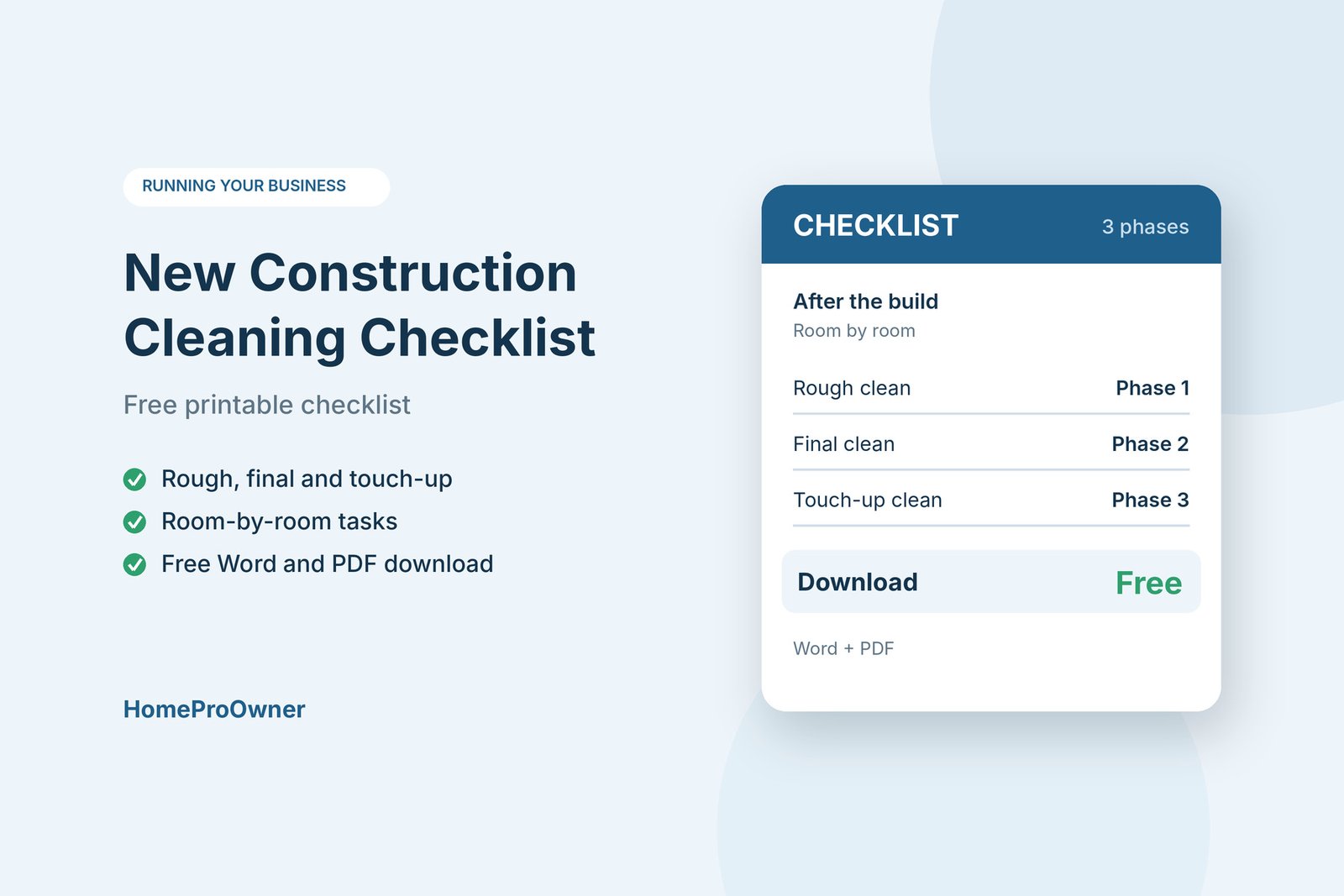
    This guide gives you a complete new construction cleaning checklist, phase by phase and room by room, plus a free printable version you can download and take to every job.

    Before you start

    A post-construction clean goes much more smoothly when the site is ready. Before you begin, confirm these points with the contractor or owner:

    • Construction work is finished. If other trades are still working, new dust will undo your work.
    • Large debris has been removed. Agree on who removes leftover materials, boxes and packaging.
    • Water and electricity are on. You’ll need both.
    • The scope is agreed in writing. Which phases, whether windows are included inside and out, who removes stickers, and whether exterior work is included.
    • Before photos are taken. Photograph every room before you start. They protect you if there’s a disagreement later.

    If you haven’t priced the job yet, our guide on how to price post-construction cleaning explains each phase and what to charge.

    Phase 1: Rough clean

    The rough clean happens during or right after construction. The goal is to remove the bulk of the dust and debris, not to make the space perfect.

    • Remove small debris and packaging (nails, screws, wood and drywall pieces).
    • Vacuum dust from floors with a HEPA-filter vacuum.
    • Do a first wipe of walls and surfaces to remove the heaviest layer of dust.
    • Clear debris from window sills and tracks.
    • Empty and bag all trash.

    Phase 2: Final clean

    The final clean happens once all construction work is complete. This is the clean that makes the building ready to live or work in. Work top to bottom, so dust falls onto areas you haven’t cleaned yet.

    Throughout the building:

    • Dust ceilings, corners and crown molding.
    • Clean light fixtures and ceiling fans.
    • Clean vents, returns and grilles.
    • Wipe walls, doors and door frames, and spot-clean marks.
    • Wipe light switches, outlets and door handles.
    • Clean baseboards.
    • Remove stickers, labels and tape from windows, fixtures and appliances.
    • Remove paint and caulk spots from hard surfaces (test on a hidden area first).

    Kitchen:

    • Clean the inside and outside of all cabinets and drawers.
    • Wipe countertops and backsplash.
    • Clean the sink and faucet.
    • Clean appliances inside and out, and remove protective film.

    Bathrooms:

    • Clean toilets, tubs and showers, including grout haze and caulk residue.
    • Clean sinks, faucets and vanities.
    • Clean mirrors and glass shower doors.
    • Wipe cabinets inside and out.

    Windows, floors and finish:

    • Clean interior windows, frames and sills (and exterior windows, if included).
    • Vacuum and mop all hard floors. Mop again if dust remains.
    • Vacuum carpets.
    • Do a final walkthrough with the client and take after photos.

    Phase 3: Touch-up clean

    Construction dust keeps settling for days after the final clean. A short touch-up visit, usually a few days later and just before move-in, makes sure the client walks into a spotless space.

    • Dust surfaces where dust has settled again: counters, sills, shelves and fixtures.
    • Wipe vents and returns again.
    • Do a quick vacuum and mop of the floors.

    Download the free checklist

    Want to take this checklist to your next job? Download the free one-page version. Print it, tick each task as you go, and leave a copy with the client to show exactly what was done.

    Tips for a better post-construction clean

    • Use the right tools. A HEPA-filter vacuum stops fine dust from going back into the air. Add plenty of microfiber cloths, scrapers for stickers and paint, and masks.
    • Change cloths often. Construction dust is abrasive. Dirty cloths spread it around and can scratch new surfaces.
    • Be careful with new finishes. New paint, wood floors and countertops can be delicate. Avoid harsh chemicals and abrasive pads unless you know the surface.
    • Ventilate. Open windows when possible to clear dust and chemical smells.
    • Plan for the touch-up. Include it in your quote from the start, so the client knows it’s part of the service.

    Frequently asked questions

    What does a new construction clean include?
    It usually includes three phases: a rough clean to remove debris and heavy dust, a final clean of every surface, fixture, cabinet, window and floor, and a touch-up clean to remove dust that settles afterward.

    How long does a new construction clean take?
    It depends on the size of the building and the amount of dust. As a rough guide, one cleaner covers around 250 square feet per hour on a final clean, so a 2,000 sq ft home takes about 8 to 9 cleaner-hours.

    Do I need to clean inside cabinets after construction?
    Yes. Construction dust gets inside cabinets and drawers, and the client will expect them to be clean before they put anything inside.

    Should I remove stickers and paint spots?
    Usually yes, but agree on it in advance. Removing stickers and paint spots takes time, so it should be included in your scope and your price.
  • How to Start a Cleaning Business With No Money (Step-by-Step)

    How to Start a Cleaning Business With No Money (Step-by-Step)

    You don’t need savings or a loan to start a cleaning business. Many successful cleaning companies began with one person, the supplies under their kitchen sink and a few friends willing to give them a chance. The secret is to start small, spend only on what your first jobs need, and let your early clients pay for everything else.

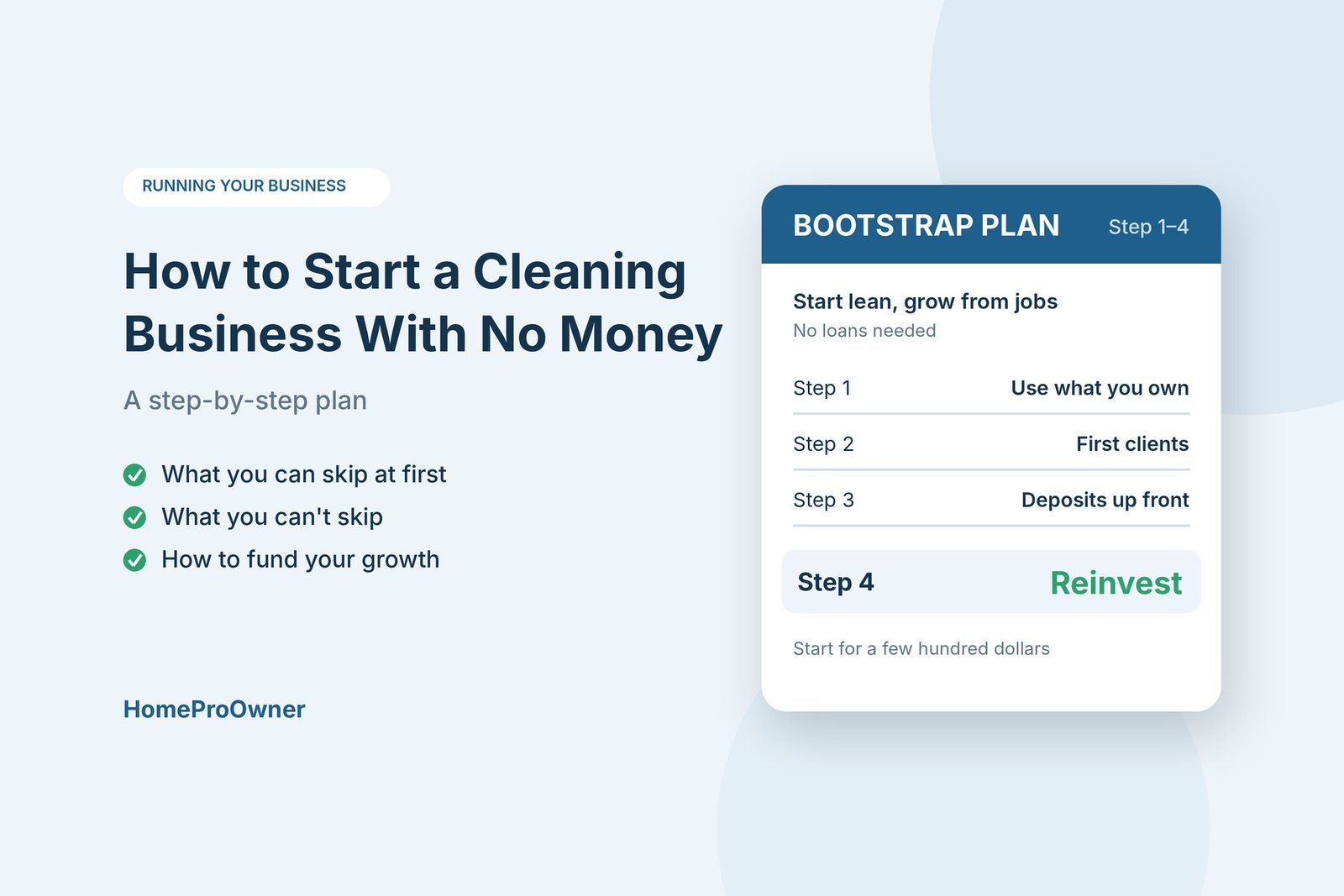
    This guide shows you how to start a cleaning business with little or no money, what you can safely skip at the beginning, what you can’t skip, and how to fund your growth from your first jobs.

    Is it really possible to start with no money?

    Almost. You can start with very little, but not with absolutely nothing. You’ll need some basic supplies, a way to get to clients, and, before long, insurance and a business license. The good news is that most of these costs can be covered by your first few jobs.

    According to Tofu, a solo residential cleaning business can launch for as little as about $300. For a full breakdown, see our guide on how much it costs to start a cleaning business.

    Step 1: Start solo and residential

    Commercial cleaning needs bigger equipment, higher insurance limits and often a team. Residential cleaning is the cheapest way to start: just you, your supplies and your car. No payroll, no second vehicle, no large contracts to fund.

    Step 2: Use what you already own

    Look around your home. You probably already have a vacuum, a mop, a bucket, cloths and some cleaning products. Use them for your first jobs. If you need to buy anything, buy only what the first job requires:

    • All-purpose cleaner, glass cleaner and disinfectant
    • Bathroom cleaner and a degreaser for kitchens
    • A pack of microfiber cloths
    • Scrub brushes, sponges and gloves
    • A caddy to carry everything

    A basic kit like this often costs around $100 to $200 if you’re starting from zero.

    Step 3: Keep the paperwork simple, but legal

    Many cleaners start as sole proprietors, which keeps registration costs low. You can form an LLC later, once you’re earning. What you shouldn’t skip:

    • A business license, if your city or county requires one. Check before your first paid job.
    • Liability insurance, before you work in clients’ homes. Paying monthly, often around $54 to $75 per month according to Housecall Pro, keeps your upfront cost low.

    Requirements vary by state and city, so check locally, and consider asking an accountant how to set up your business.

    Step 4: Get your first clients for free

    You don’t need a marketing budget. Start with:

    • Your network: message friends, family and neighbors one by one.
    • A Google Business Profile: free, and one of the best ways for local clients to find you.
    • Local groups: Nextdoor and neighborhood Facebook groups.

    Our guide on how to get your first cleaning clients includes message scripts and a 30-day plan.

    Step 5: Price your work properly from day one

    When money is tight, it’s tempting to charge very little to win jobs. Don’t. Underpricing means you work hard and still can’t afford supplies, insurance or gas. Price based on the real time each job takes, and include your costs. Our cleaning estimate guide and calculator will help you set fair prices.

    Step 6: Get paid on time, and ask for deposits

    Cash flow matters more than anything when you start with no money:

    • Get paid on the day of the clean, by card or bank transfer.
    • Ask for a deposit on larger jobs, like deep cleans and move-out cleans. A 25% to 50% deposit can cover any extra supplies the job needs.
    • Put your terms in writing, including your cancellation policy.

    Step 7: Reinvest your first earnings

    Your first paychecks are your startup capital. Reinvest them in this order:

    1. Insurance, if you don’t have it yet.
    2. A better vacuum, your most important tool.
    3. A full supply kit, so you never run out mid-job.
    4. Simple marketing: business cards, flyers and photos for your Google profile.
    5. Scheduling and invoicing software, once managing clients by hand gets messy.

    And set money aside for taxes from every payment. Many new business owners are surprised by their first tax bill. An accountant can tell you how much to save.

    A simple 90-day plan

    PeriodFocusGoal
    Days 1–30Network, first clients, basic suppliesFirst 3 to 5 paying jobs
    Days 31–60License, insurance, Google profile, reviewsFirst recurring clients
    Days 61–90Reinvest in equipment and marketingA steady weekly schedule

    Common mistakes to avoid

    • Buying equipment you don’t need yet. Buy for the jobs you have.
    • Charging too little to win clients. It leaves you with no money to grow.
    • Working without insurance. One accident can cost far more than a year of premiums.
    • Spending everything you earn. Reinvest and save for taxes.
    • Waiting until everything is perfect. Your first client matters more than your logo.

    Frequently asked questions

    Can I really start a cleaning business with no money?
    You can start with very little. With the supplies you already own, free marketing and your first jobs paying for insurance and equipment, many people start with just a few hundred dollars.

    Do I need an LLC to start a cleaning business?
    Not necessarily. Many cleaners start as sole proprietors and form an LLC later. Check your state’s rules and consider professional advice.

    What supplies do I need for my first cleaning job?
    All-purpose cleaner, glass cleaner, disinfectant, bathroom cleaner, a degreaser, microfiber cloths, scrub brushes, gloves, a vacuum and a mop.

    How fast can a cleaning business make money?
    Very fast compared with most businesses. Because startup costs are low, many cleaners cover their startup costs within their first few jobs.

  • How Much Does It Cost to Start a Cleaning Business? (2026 Breakdown)

    How Much Does It Cost to Start a Cleaning Business? (2026 Breakdown)

    One of the best things about starting a cleaning business is how little money you need. Unlike a restaurant or a retail store, you don’t need a location, expensive machinery or inventory. Many residential cleaners start with a few hundred dollars and grow from there.

    But “cheap to start” doesn’t mean “free”. Insurance, supplies, licenses and marketing all add up, and it helps to know the real numbers before you begin. This guide breaks down every startup cost, shows two example budgets, and includes a free calculator to estimate your own.

    Startup costs at a glance

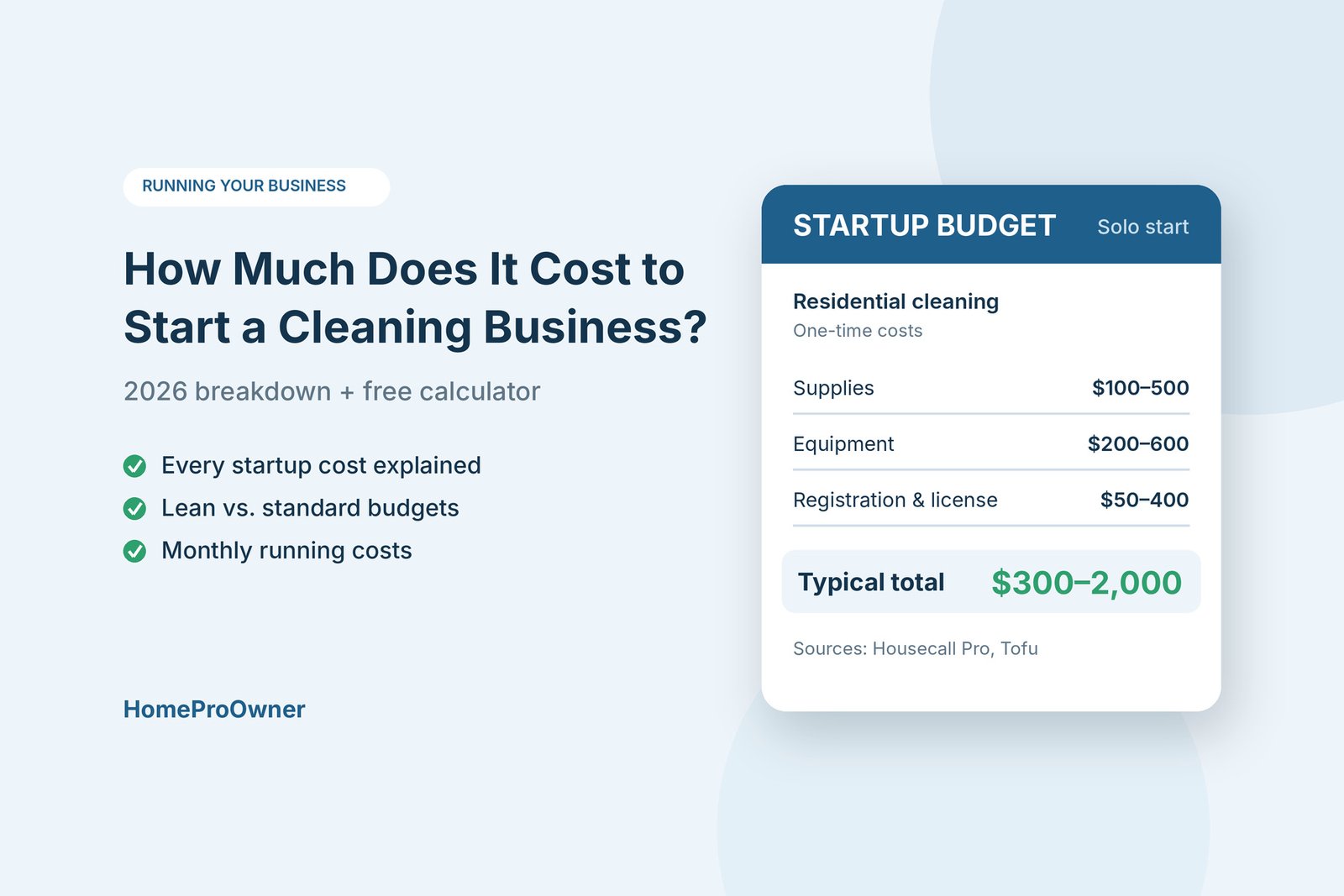
    Here are typical one-time and recurring costs for a residential cleaning business in the U.S., based on 2026 data from Housecall Pro and Tofu:

    CostTypical rangeType
    Cleaning supplies and chemicals$100–$500One-time, then monthly refills
    Equipment (vacuum, mop, microfiber, caddy)$200–$600One-time
    Business registration or LLC$0–$500One-time, varies by state
    Business license or permit$50–$200One-time or yearly
    General liability insurance$54–$75 per month, or $500–$1,200 per yearRecurring
    Bonding$100–$300 per yearYearly
    Marketing (cards, website, Google profile)$0–$500One-time to start

    Both sources agree that a solo residential cleaning business can launch for well under $2,000. Tofu estimates a range of about $300 to $2,000, and Housecall Pro says many residential businesses can start for under $1,000. Commercial cleaning usually costs more, because it needs bigger equipment, a vehicle and higher insurance limits.

    What each cost covers

    Supplies. All-purpose cleaner, glass cleaner, disinfectant, degreaser, bathroom cleaner, microfiber cloths, sponges, scrub brushes, gloves and trash bags. Start with what your first jobs need and add specialty products later.

    Equipment. A good vacuum is your most important tool. Add a mop and bucket, a cleaning caddy, an extendable duster and a step stool. You can upgrade as you grow; a HEPA vacuum becomes important if you take on deep or post-construction cleans.

    Registration. Many cleaners start as sole proprietors, which can cost little or nothing. Forming an LLC typically costs between $50 and $500 depending on your state, and can help separate your personal and business finances. Check your state’s requirements, and consider talking to an accountant.

    Licenses. Most cities or counties require a general business license. A special cleaning license usually isn’t needed for basic residential cleaning, but rules vary. In California, for example, janitorial companies must register with the state. Always check your city, county and state.

    Insurance. General liability insurance protects you if you damage something or someone gets hurt in a client’s home. Many clients will ask whether you’re insured, and saying yes helps you win jobs. Paying monthly keeps your upfront cost low.

    Bonding. A janitorial bond protects clients against theft by you or your staff. It’s not always required for residential work, but it builds trust and is often required for commercial contracts.

    Marketing. You can start almost for free with a Google Business Profile and messages to your network, as explained in our guide on how to get your first cleaning clients. Business cards and simple flyers cost little.

    Two example budgets

    Lean start (solo, residential):

    ItemCost
    Supplies (using some you already own)$100
    Basic equipment$200
    Sole proprietor registration$50
    Local business license$50
    Liability insurance, first month$55
    Business cards$20
    Total to start$475

    Standard start (solo, more prepared):

    ItemCost
    Full supply kit$300
    Better equipment, including a quality vacuum$600
    LLC formation$200
    Business license$100
    Liability insurance, paid yearly$800
    Bonding$200
    Website, cards and flyers$300
    Total to start$2,500

    The lean budget gets you working fast. The standard budget makes you look more established from day one. Both are valid; many owners start lean and upgrade with their first earnings.

    Don’t forget your monthly running costs

    Startup costs are only half the picture. Once you’re working, you’ll have recurring costs. Housecall Pro estimates:

    • Insurance: $54–$75 per month
    • Supply refills: $50–$300 per month
    • Transportation (gas, maintenance, parking): $100–$500 per month
    • Marketing: $150–$1,000+ per month, although you can keep this much lower at first with free methods
    • Software: varies by plan; many scheduling and invoicing tools have free or low-cost options

    Your prices need to cover these costs, plus your own pay and taxes. If you haven’t set your prices yet, our guide on how to write a cleaning estimate includes a free pricing calculator.

    Calculate your own startup costs

    Use the calculator below to estimate how much you need to start, your monthly costs, and how many jobs it takes to cover them. The default numbers are a lean, solo residential start.

    Cleaning Business Startup Cost Calculator

    The default numbers are a lean, solo residential start. Change any amount to match your situation. Enter 0 for anything you already have.

    One-time startup costs ($)

    Cleaning supplies
    Equipment (vacuum, mop, caddy)
    Business registration / LLC
    Business license
    Bonding (yearly)
    Cards, flyers, website

    Monthly running costs ($)

    Liability insurance
    Supply refills
    Gas and transportation
    Software and phone
    Marketing
    Your average price per job ($)
    Startup costs$0
    Monthly costs$0
    Money needed for your first month$0
    Jobs per month to cover running costs0
    Jobs to earn back your startup costs0

    Estimates only. Costs vary by state and city, and the job counts don’t include your own pay or taxes. Check local licensing and insurance requirements before you start.

    How to keep your startup costs low

    • Start solo and residential. No payroll, no second vehicle, lower insurance.
    • Use what you already have. Your own vacuum and supplies can cover your first jobs.
    • Buy for the jobs you have, not the jobs you hope to get. Specialty equipment can wait.
    • Pay insurance monthly instead of yearly to protect your cash.
    • Market for free first. Your network, your Google profile and local groups cost nothing.
    • Reinvest your first earnings into better equipment and marketing.

    For a full plan, read our guide on how to start a cleaning business with no money.

    Frequently asked questions

    How much does it cost to start a cleaning business?
    A solo residential cleaning business typically costs between $300 and $2,000 to start, depending on how much equipment you buy and whether you form an LLC and pay insurance yearly.

    Do I need a license to start a cleaning business?
    Most cities or counties require a general business license. A special cleaning license usually isn’t needed for basic residential cleaning, but requirements vary by state and city, so always check locally.

    Do I need insurance to start a cleaning business?
    It’s strongly recommended before you work in anyone’s home. General liability insurance protects you if something goes wrong, and many clients will ask about it.

    Is it cheaper to start a residential or commercial cleaning business?
    Residential is usually cheaper. Commercial cleaning often requires bigger equipment, a vehicle, higher insurance limits and bonding.