
Category: Getting Clients

Practical guides to help cleaning business owners find, win and keep clients.

  • How to Get Commercial Cleaning Contracts (A Practical Guide)

    How to Get Commercial Cleaning Contracts (A Practical Guide)

    Commercial cleaning contracts can transform a cleaning business. Instead of one-off jobs, you get recurring work, often several visits a week, with predictable income month after month. A single office contract can be worth thousands of dollars a month.

    But commercial clients buy differently from homeowners. They compare bids, expect professional proposals and care about reliability above everything else. This guide explains where to find commercial cleaning contracts, how to price your bid and how to write a proposal that wins.

    Is commercial cleaning right for you?

    Commercial work has big advantages: recurring revenue, larger contracts and clients who book for months or years. It also has trade-offs:

    • Evening and weekend work. Most offices want cleaning outside business hours.
    • Higher requirements. Many clients ask for proof of insurance, bonding and references.
    • Lower rates per square foot. Commercial spaces are larger and cleaned more often, so the price per visit is lower relative to the size.
    • More competition on price. Businesses often collect several bids.

    Many cleaning businesses start residential and add commercial clients once they have experience, insurance and a few references.

    Get ready before you bid

    Before you approach commercial clients, make sure you have:

    • General liability insurance and a janitorial bond. Many businesses won’t consider a cleaner without them. Housecall Pro estimates core insurance and bonding at about $700 per year for a small business, though costs vary.
    • A simple, professional proposal template.
    • References. Even residential clients can vouch for your reliability.
    • A clear service menu, such as daily, weekly and monthly tasks.

    Where to find commercial cleaning contracts

    1. Small local businesses. Dental offices, small medical practices, real estate offices, insurance agencies, gyms and boutique shops. They often don’t have a cleaner, or aren’t happy with the one they have. Walk in, ask for the manager or owner, and leave a short one-page flyer with your contact details.

    2. Property managers. They manage office buildings, retail centers and apartment complexes, and need cleaning for common areas, vacant units and offices. One relationship can lead to several properties.

    3. Contractors and builders. They need post-construction cleaning when they finish projects, and those jobs often lead to ongoing cleaning for the new tenants. Our new construction cleaning checklist helps you show contractors you know the work.

    4. Your existing clients. Ask your residential clients where they work. Many are business owners or managers who decide who cleans their office.

    5. Local networking. Your chamber of commerce, local business groups and networking events put you in front of decision-makers.

    6. Government contracts. Federal cleaning opportunities are posted on SAM.gov, and many cities, counties and school districts publish their own bids. These contracts often have strict requirements and longer processes, so they’re usually a better fit once you have experience.

    How to price a commercial cleaning bid

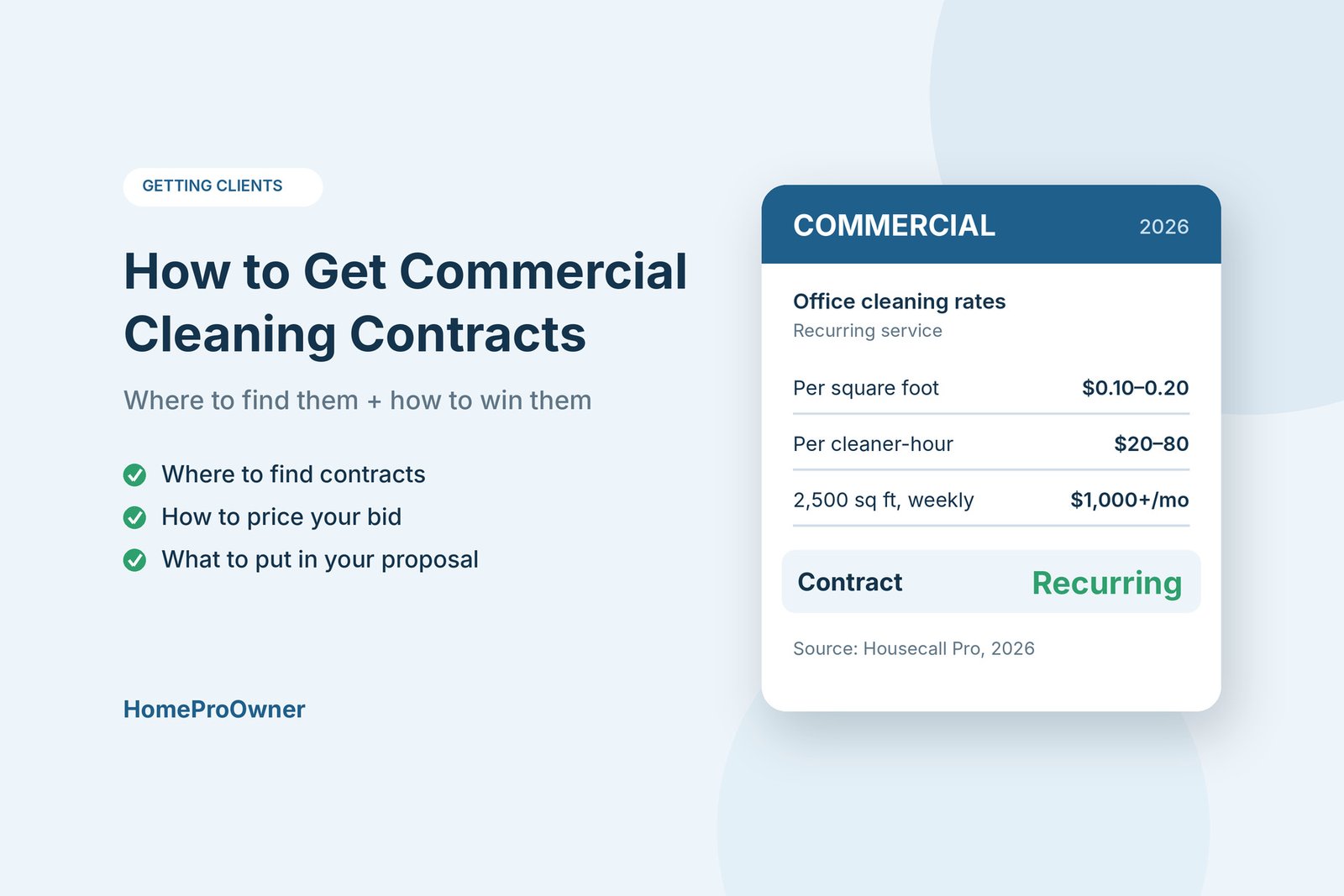
    Commercial cleaning is usually priced per square foot or as a monthly contract. According to Housecall Pro’s 2026 commercial pricing guide, office cleaning typically runs $0.10 to $0.20 per square foot per visit, and general commercial cleaning runs $20 to $80 per cleaner-hour.

    Here’s what that looks like for an office cleaned once a week (4 visits per month):

    Office sizePer visitPer month
    1,000 sq ft$100–$200$400–$800
    2,500 sq ft$250–$500$1,000–$2,000
    5,000 sq ft$500–$1,000$2,000–$4,000

    Rates vary by building type. Jobber notes that medical offices and restaurants usually cost more per square foot because of disinfection and grease, while large, simple spaces cost less.

    The most reliable way to price is the same one we recommend for every job: estimate the labor hours first, multiply by your hourly rate, and then check the result against the per-square-foot range. Commercial spaces vary too much to price by square footage alone.

    What to include in your proposal

    A commercial proposal should be clear, professional and easy to compare with other bids:

    • A short introduction: who you are, how long you’ve been in business and why you’re reliable.
    • A detailed scope of work: tasks by area (offices, restrooms, kitchen, common areas) and frequency (each visit, weekly, monthly).
    • Your price: per visit and per month, with optional add-ons like carpet cleaning or interior windows listed separately.
    • Your schedule: days and times of service.
    • Proof of insurance and bonding.
    • Terms: contract length, payment terms, notice period and how quality issues are handled.

    Before you write the proposal, always do a walkthrough of the space. Look at floor types, restrooms, kitchens, high-traffic areas and anything that needs special care. Then follow up within a few days of sending it.

    Tips to win (and keep) the contract

    • Compete on reliability, not just price. Businesses switch cleaners mostly because of missed visits and inconsistent quality.
    • Offer a trial period. A one-month trial lowers the risk for the client.
    • Adjust scope instead of cutting your rate. If a client pushes back on price, offer fewer visits or fewer tasks, or a longer contract, rather than lowering your hourly rate.
    • Communicate. Leave a note after each visit, or send a short monthly check-in.
    • Ask for referrals. Satisfied business owners often know other owners.

    Common mistakes to avoid

    • Bidding without a walkthrough. You’ll miss the details that make a space take longer.
    • Underestimating the time. Restrooms and kitchens take longer than open office space.
    • Forgetting travel and setup time, especially for short, frequent visits.
    • Vague scopes. “Clean the office” leads to disputes. List every task and frequency.
    • Signing long contracts without a price review. Include a clause to review prices every year.

    Frequently asked questions

    How do I get my first commercial cleaning contract?
    Start with small local businesses near you, such as dental offices, real estate agencies and small shops. Visit in person, leave a simple flyer, and ask your residential clients whether their workplace needs a cleaner.

    How much should I charge for commercial cleaning?
    Office cleaning typically runs between $0.10 and $0.20 per square foot per visit, according to Housecall Pro. Always estimate your labor hours first and check the result against that range.

    Do I need insurance for commercial cleaning?
    In practice, yes. Most commercial clients will ask for proof of general liability insurance, and many also require a janitorial bond.

    How long are commercial cleaning contracts?
    It varies. Many start with a trial month or a short agreement, then move to 6- or 12-month contracts with a notice period.
  • How to Get Your First Cleaning Clients (A Practical 30-Day Plan)

    How to Get Your First Cleaning Clients (A Practical 30-Day Plan)

    Getting your first cleaning clients is the hardest part of starting a cleaning business. You have no reviews, no referrals and no track record, and every potential client is wondering the same thing: can I trust this person in my home?

    The good news is that you don’t need a big marketing budget to get started. Most new cleaning businesses land their first clients through people they already know, local communities and a free Google profile. This guide walks you through seven practical ways to find clients, with message scripts you can copy and a simple 30-day plan.

    Before you look for clients: get ready

    A few things will make every method below work better. Take care of them first.

    • Know your prices. When someone asks “how much?”, you need a confident answer. If you haven’t set your prices yet, read our guide on how to write a cleaning estimate and try the free calculator.
    • Define a simple offer. For example: standard cleans for recurring clients, deep cleans for first visits and move-out cleans. Three clear services are easier to sell than ten vague ones.
    • Look professional. A business phone number or a separate line, a dedicated email address and a short description of what you do. You don’t need a fancy website yet.
    • Get basic insurance. Many clients will ask if you’re insured, and being able to say yes removes one of their biggest worries. Check what’s required and recommended in your state.
    • Take before-and-after photos. Clean your own home, or a friend’s, and photograph the results. Until you have reviews, photos are your proof.

    1. Start with people who already know you

    Your first clients are usually closer than you think. Friends, family, neighbors, former coworkers, people from your gym or church: they already trust you, which is the hardest thing to build.

    Don’t just tell them you started a business. Ask them directly, and ask them to pass it on. A short, personal message works far better than a generic post:

    “Hi Sarah! I’ve just started my own home cleaning business here in [city]. I’m taking on my first clients this month and offering 15% off the first clean. Do you know anyone who might need a hand, or would you like to try it yourself? I’d really appreciate it if you passed my number along.”

    Send it one by one, not as a group message. Personal messages get replies; mass messages get ignored.

    2. Set up your Google Business Profile

    When someone searches “house cleaning near me”, Google shows a map with local businesses at the top. Being on that map is free, and for a local service business it’s one of the most valuable things you can do.

    To set it up:

    1. Go to Google Business Profile and create a profile for your business.
    2. Choose a category like “House cleaning service” and set your service area (the cities or ZIP codes you cover). You can hide your home address.
    3. Add your phone number, hours, a short description and your before-and-after photos.
    4. Complete Google’s verification process.

    Then focus on reviews. Ask every satisfied client, including friends and family you’ve cleaned for, to leave an honest review. Reviews are one of the main factors in how high you appear on the map, and they’re what convinces strangers to call you.

    3. Use local online communities

    Neighborhood groups are where people ask “Can anyone recommend a good cleaner?” every single week. The key platforms are Nextdoor and local Facebook groups for your town or neighborhood.

    Two ways to use them:

    • Answer recommendation requests. Search the group for “cleaner” or “cleaning” and set up alerts. Reply quickly, politely and briefly, and ask satisfied clients to recommend you in those threads too.
    • Introduce yourself once, properly. Most groups allow a business introduction if it’s genuine and local. Share who you are, what areas you cover, a photo and a simple offer. Don’t post the same ad every day; it annoys people and can get you removed.

    Example post:

    “Hi neighbors! I’m Maria, and I live here in Oak Park. I’ve just started a home cleaning business focused on recurring weekly and biweekly cleans. I’m fully insured and bring all my own supplies. I’m offering 15% off the first clean for neighbors this month. Happy to answer any questions!”

    4. Partner with people who find clients for you

    Some businesses meet people who need cleaning every week. A few good partnerships can bring you a steady flow of jobs without any advertising:

    • Real estate agents: they need homes cleaned before listing photos and after sales.
    • Property managers and landlords: they need move-out cleans every time a tenant leaves.
    • Airbnb and short-term rental hosts: they need a reliable cleaner between every guest.
    • Moving companies: their clients are moving out of one home and into another.
    • Contractors and remodelers: they need post-construction cleanups.

    Introduce yourself with a short email or a visit, explain what you offer and leave your contact details. The first job for a partner is a test, so treat it like an audition: be on time, do excellent work and send photos when you finish. Since many of these jobs are deep or move-out cleans, make sure you know how to price a deep cleaning job before you quote.

    5. Go old school with flyers and door hangers

    Flyers still work for cleaning businesses, if you use them well. The trick is to be targeted: choose neighborhoods where people are likely to pay for cleaning, and where you’d want to work, close to your other clients.

    A good flyer has one clear offer, a photo, your phone number in large print, and a reason to act now, like a discount for the first clean this month. Leave a stack at local spots where it’s allowed, such as coffee shops, gyms and community boards. Always follow local rules: in the U.S., you can’t put flyers inside mailboxes.

    6. Try lead marketplaces carefully

    Platforms like Thumbtack and Angi connect you with people actively looking for cleaners. They can be useful when you’re starting out, but you usually pay for leads or bookings, and costs vary by location and category. Check the current pricing in your area before you commit.

    If you use them, two rules make a big difference:

    • Respond fast. Clients often contact several cleaners at once, and the first good reply usually wins.
    • Track your numbers. Note how much you spend and how many paying clients you get. If a platform costs more per client than you earn from that client’s first few cleans, stop and focus on free channels.

    7. Add paid ads once you know your numbers

    Google Ads and Local Services Ads can work very well for cleaning businesses. According to WordStream’s 2025 home services benchmarks, as summarized by Web Tonic, cleaning services convert at 17.65% from ads, more than double the 7.33% average for home services, at an average cost of about $47 per lead.

    That’s encouraging, but $47 per lead adds up quickly when you’re starting out. Paid ads make the most sense after you know your prices, your closing rate and how much a recurring client is worth to you. Start with the free methods first.

    Turn your first clients into more clients

    Your first clients are your best marketing channel. Three habits make them bring you more:

    • Ask for a review after every great clean. Send the direct link to your Google review page, so it takes them 30 seconds.
    • Create a simple referral offer. For example: “Refer a friend and you both get $25 off your next clean.”
    • Offer recurring service. After a first deep clean, suggest a weekly or biweekly plan. One recurring client is worth far more than several one-off jobs.

    Your 30-day plan

    WeekFocusActions
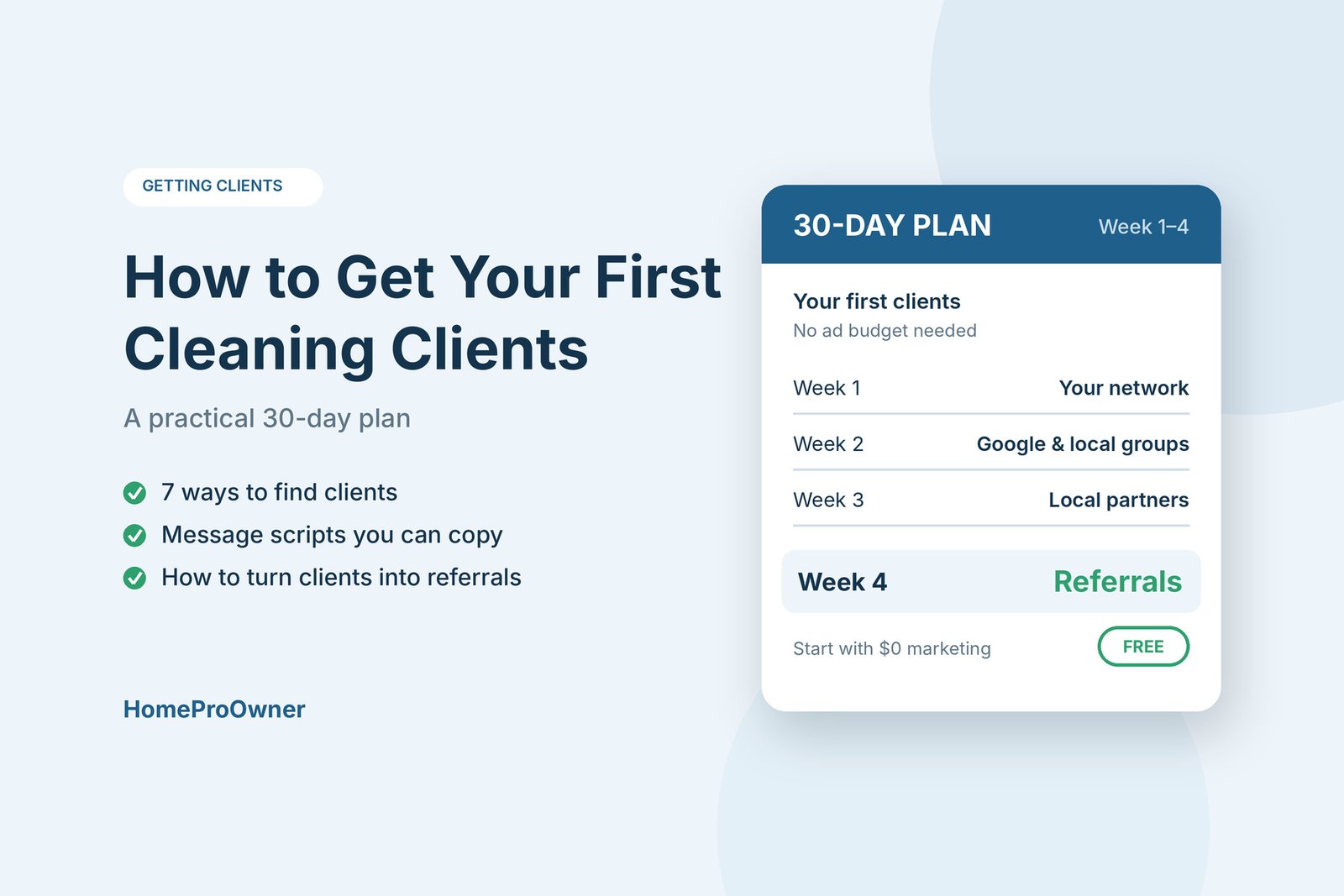
    Week 1Your networkSet your prices and offer, take photos, message 30 people you know one by one
    Week 2Google and local groupsCreate your Google Business Profile, join 3 to 5 local groups and post an introduction
    Week 3Local partnersContact 10 realtors, property managers or Airbnb hosts in your area
    Week 4Reviews and referralsAsk every client for a review, launch your referral offer, offer recurring plans

    Common mistakes to avoid

    • Waiting until everything is perfect. You don’t need a website, a logo or a big budget to get your first client. You need to ask people.
    • Competing only on price. Being the cheapest attracts clients who leave for someone cheaper. Compete on reliability and quality.
    • Spamming local groups. One genuine introduction beats ten copy-paste ads.
    • Forgetting to follow up. If someone asks for a quote and goes quiet, send a friendly message two or three days later.
    • Not asking for reviews. Happy clients rarely leave reviews unless you ask.

    Frequently asked questions

    How long does it take to get your first cleaning client?
    It varies, but many new cleaners land their first job within a few weeks by reaching out to their personal network. Building a full schedule of recurring clients usually takes a few months.

    Should I offer a discount to get my first clients?
    A small first-clean discount, like 10% to 15%, can help people take a chance on you. Avoid big discounts on recurring service, because clients get used to that price.

    Do I need a website to get cleaning clients?
    Not at first. A complete Google Business Profile with photos and reviews does most of the work. A simple website becomes useful later, to look more established and rank in search.

    What’s the best way to get recurring clients?
    Offer recurring service right after an excellent first clean, when the client is most impressed. Give them a clear reason to commit, such as a lower per-visit price for weekly or biweekly plans.