
Getting your first cleaning clients is the hardest part of starting a cleaning business. You have no reviews, no referrals and no track record, and every potential client is wondering the same thing: can I trust this person in my home?
The good news is that you don’t need a big marketing budget to get started. Most new cleaning businesses land their first clients through people they already know, local communities and a free Google profile. This guide walks you through seven practical ways to find clients, with message scripts you can copy and a simple 30-day plan.
Before you look for clients: get ready
A few things will make every method below work better. Take care of them first.
- Know your prices. When someone asks “how much?”, you need a confident answer. If you haven’t set your prices yet, read our guide on how to write a cleaning estimate and try the free calculator.
- Define a simple offer. For example: standard cleans for recurring clients, deep cleans for first visits and move-out cleans. Three clear services are easier to sell than ten vague ones.
- Look professional. A business phone number or a separate line, a dedicated email address and a short description of what you do. You don’t need a fancy website yet.
- Get basic insurance. Many clients will ask if you’re insured, and being able to say yes removes one of their biggest worries. Check what’s required and recommended in your state.
- Take before-and-after photos. Clean your own home, or a friend’s, and photograph the results. Until you have reviews, photos are your proof.
1. Start with people who already know you
Your first clients are usually closer than you think. Friends, family, neighbors, former coworkers, people from your gym or church: they already trust you, which is the hardest thing to build.
Don’t just tell them you started a business. Ask them directly, and ask them to pass it on. A short, personal message works far better than a generic post:
“Hi Sarah! I’ve just started my own home cleaning business here in [city]. I’m taking on my first clients this month and offering 15% off the first clean. Do you know anyone who might need a hand, or would you like to try it yourself? I’d really appreciate it if you passed my number along.”
Send it one by one, not as a group message. Personal messages get replies; mass messages get ignored.
2. Set up your Google Business Profile
When someone searches “house cleaning near me”, Google shows a map with local businesses at the top. Being on that map is free, and for a local service business it’s one of the most valuable things you can do.
To set it up:
- Go to Google Business Profile and create a profile for your business.
- Choose a category like “House cleaning service” and set your service area (the cities or ZIP codes you cover). You can hide your home address.
- Add your phone number, hours, a short description and your before-and-after photos.
- Complete Google’s verification process.
Then focus on reviews. Ask every satisfied client, including friends and family you’ve cleaned for, to leave an honest review. Reviews are one of the main factors in how high you appear on the map, and they’re what convinces strangers to call you.
3. Use local online communities
Neighborhood groups are where people ask “Can anyone recommend a good cleaner?” every single week. The key platforms are Nextdoor and local Facebook groups for your town or neighborhood.
Two ways to use them:
- Answer recommendation requests. Search the group for “cleaner” or “cleaning” and set up alerts. Reply quickly, politely and briefly, and ask satisfied clients to recommend you in those threads too.
- Introduce yourself once, properly. Most groups allow a business introduction if it’s genuine and local. Share who you are, what areas you cover, a photo and a simple offer. Don’t post the same ad every day; it annoys people and can get you removed.
Example post:
“Hi neighbors! I’m Maria, and I live here in Oak Park. I’ve just started a home cleaning business focused on recurring weekly and biweekly cleans. I’m fully insured and bring all my own supplies. I’m offering 15% off the first clean for neighbors this month. Happy to answer any questions!”
4. Partner with people who find clients for you
Some businesses meet people who need cleaning every week. A few good partnerships can bring you a steady flow of jobs without any advertising:
- Real estate agents: they need homes cleaned before listing photos and after sales.
- Property managers and landlords: they need move-out cleans every time a tenant leaves.
- Airbnb and short-term rental hosts: they need a reliable cleaner between every guest.
- Moving companies: their clients are moving out of one home and into another.
- Contractors and remodelers: they need post-construction cleanups.
Introduce yourself with a short email or a visit, explain what you offer and leave your contact details. The first job for a partner is a test, so treat it like an audition: be on time, do excellent work and send photos when you finish. Since many of these jobs are deep or move-out cleans, make sure you know how to price a deep cleaning job before you quote.
5. Go old school with flyers and door hangers
Flyers still work for cleaning businesses, if you use them well. The trick is to be targeted: choose neighborhoods where people are likely to pay for cleaning, and where you’d want to work, close to your other clients.
A good flyer has one clear offer, a photo, your phone number in large print, and a reason to act now, like a discount for the first clean this month. Leave a stack at local spots where it’s allowed, such as coffee shops, gyms and community boards. Always follow local rules: in the U.S., you can’t put flyers inside mailboxes.
6. Try lead marketplaces carefully
Platforms like Thumbtack and Angi connect you with people actively looking for cleaners. They can be useful when you’re starting out, but you usually pay for leads or bookings, and costs vary by location and category. Check the current pricing in your area before you commit.
If you use them, two rules make a big difference:
- Respond fast. Clients often contact several cleaners at once, and the first good reply usually wins.
- Track your numbers. Note how much you spend and how many paying clients you get. If a platform costs more per client than you earn from that client’s first few cleans, stop and focus on free channels.
7. Add paid ads once you know your numbers
Google Ads and Local Services Ads can work very well for cleaning businesses. According to WordStream’s 2025 home services benchmarks, as summarized by Web Tonic, cleaning services convert at 17.65% from ads, more than double the 7.33% average for home services, at an average cost of about $47 per lead.
That’s encouraging, but $47 per lead adds up quickly when you’re starting out. Paid ads make the most sense after you know your prices, your closing rate and how much a recurring client is worth to you. Start with the free methods first.
Turn your first clients into more clients
Your first clients are your best marketing channel. Three habits make them bring you more:
- Ask for a review after every great clean. Send the direct link to your Google review page, so it takes them 30 seconds.
- Create a simple referral offer. For example: “Refer a friend and you both get $25 off your next clean.”
- Offer recurring service. After a first deep clean, suggest a weekly or biweekly plan. One recurring client is worth far more than several one-off jobs.
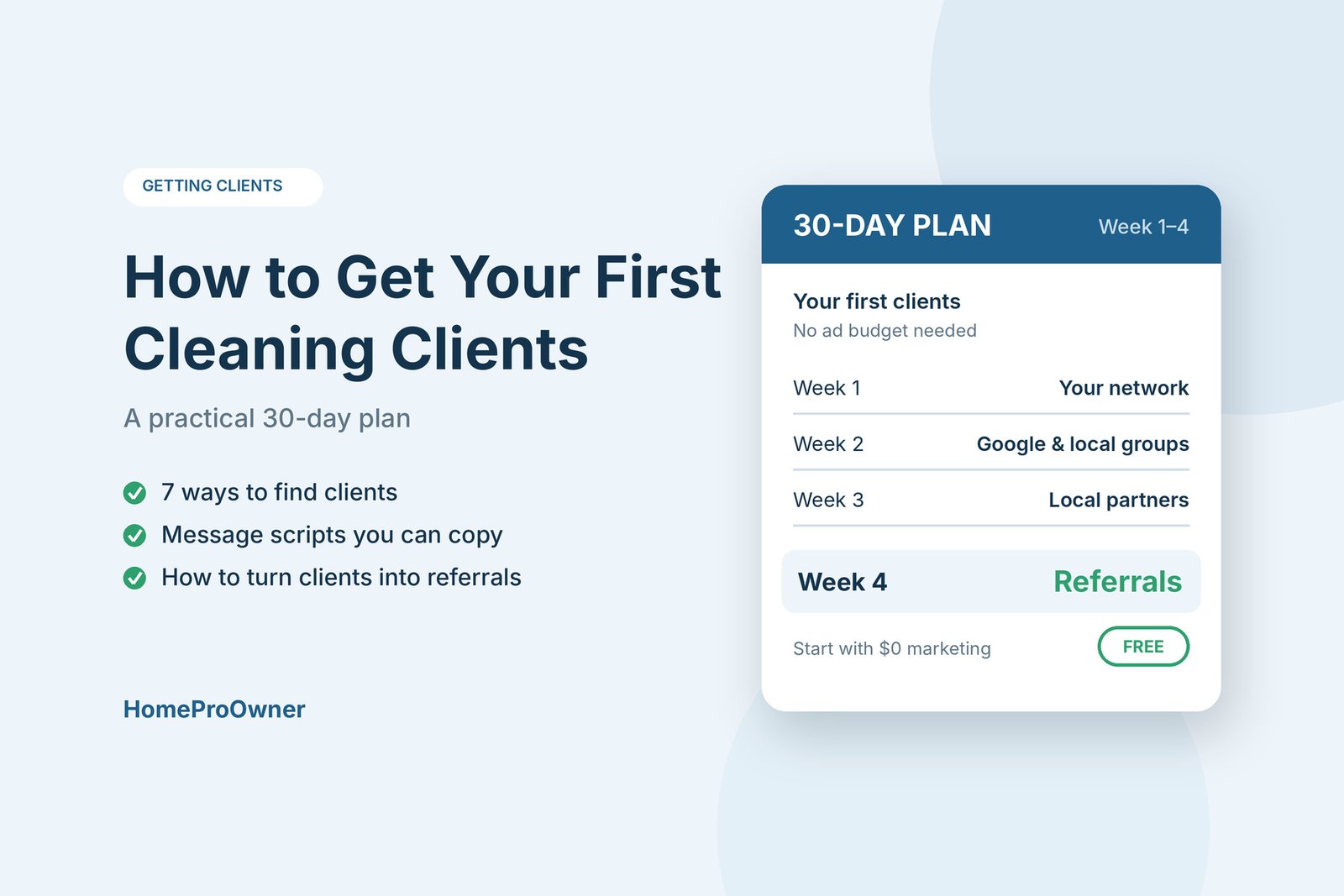
Your 30-day plan
| Week | Focus | Actions |
|---|---|---|
| Week 1 | Your network | Set your prices and offer, take photos, message 30 people you know one by one |
| Week 2 | Google and local groups | Create your Google Business Profile, join 3 to 5 local groups and post an introduction |
| Week 3 | Local partners | Contact 10 realtors, property managers or Airbnb hosts in your area |
| Week 4 | Reviews and referrals | Ask every client for a review, launch your referral offer, offer recurring plans |
Common mistakes to avoid
- Waiting until everything is perfect. You don’t need a website, a logo or a big budget to get your first client. You need to ask people.
- Competing only on price. Being the cheapest attracts clients who leave for someone cheaper. Compete on reliability and quality.
- Spamming local groups. One genuine introduction beats ten copy-paste ads.
- Forgetting to follow up. If someone asks for a quote and goes quiet, send a friendly message two or three days later.
- Not asking for reviews. Happy clients rarely leave reviews unless you ask.
Frequently asked questions
How long does it take to get your first cleaning client?
It varies, but many new cleaners land their first job within a few weeks by reaching out to their personal network. Building a full schedule of recurring clients usually takes a few months.
Should I offer a discount to get my first clients?
A small first-clean discount, like 10% to 15%, can help people take a chance on you. Avoid big discounts on recurring service, because clients get used to that price.
Do I need a website to get cleaning clients?
Not at first. A complete Google Business Profile with photos and reviews does most of the work. A simple website becomes useful later, to look more established and rank in search.
What’s the best way to get recurring clients?
Offer recurring service right after an excellent first clean, when the client is most impressed. Give them a clear reason to commit, such as a lower per-visit price for weekly or biweekly plans.