
Deep cleans are some of the most profitable jobs a cleaning business can take on, and some of the easiest to underprice. They take longer than you expect, the condition of the home is hard to judge from a phone call, and every source online seems to give a different number for how much more you should charge.
This guide shows you what a deep clean should include, what cleaning businesses actually charge in 2026, and a simple method to price any deep clean, with two worked examples.
What counts as a deep clean?
A deep clean covers everything in a standard clean, plus the areas that build up dirt over months. Being clear about the difference is the first step to pricing it right, because if the client thinks “deep clean” means “a slightly longer regular clean,” you’ll end up doing far more work than you charged for.
| Task | Standard clean | Deep clean |
|---|---|---|
| Dust surfaces, vacuum and mop floors | ✓ | ✓ |
| Clean kitchen counters, sink and stovetop | ✓ | ✓ |
| Clean toilets, showers, tubs and sinks | ✓ | ✓ |
| Baseboards, door frames and light switches | ✓ | |
| Ceiling fans, light fixtures and vents | ✓ | |
| Scrub grout and remove soap scum and limescale | ✓ | |
| Degrease kitchen cabinet fronts and backsplash | ✓ | |
| Clean behind and under furniture and appliances | ✓ | |
| Window sills and tracks | ✓ | |
| Inside oven, fridge or cabinets | Usually an add-on |
Write this list into your estimate. It sets expectations and protects you if a client later asks why the inside of the oven wasn’t cleaned.
How much to charge for a deep clean in 2026
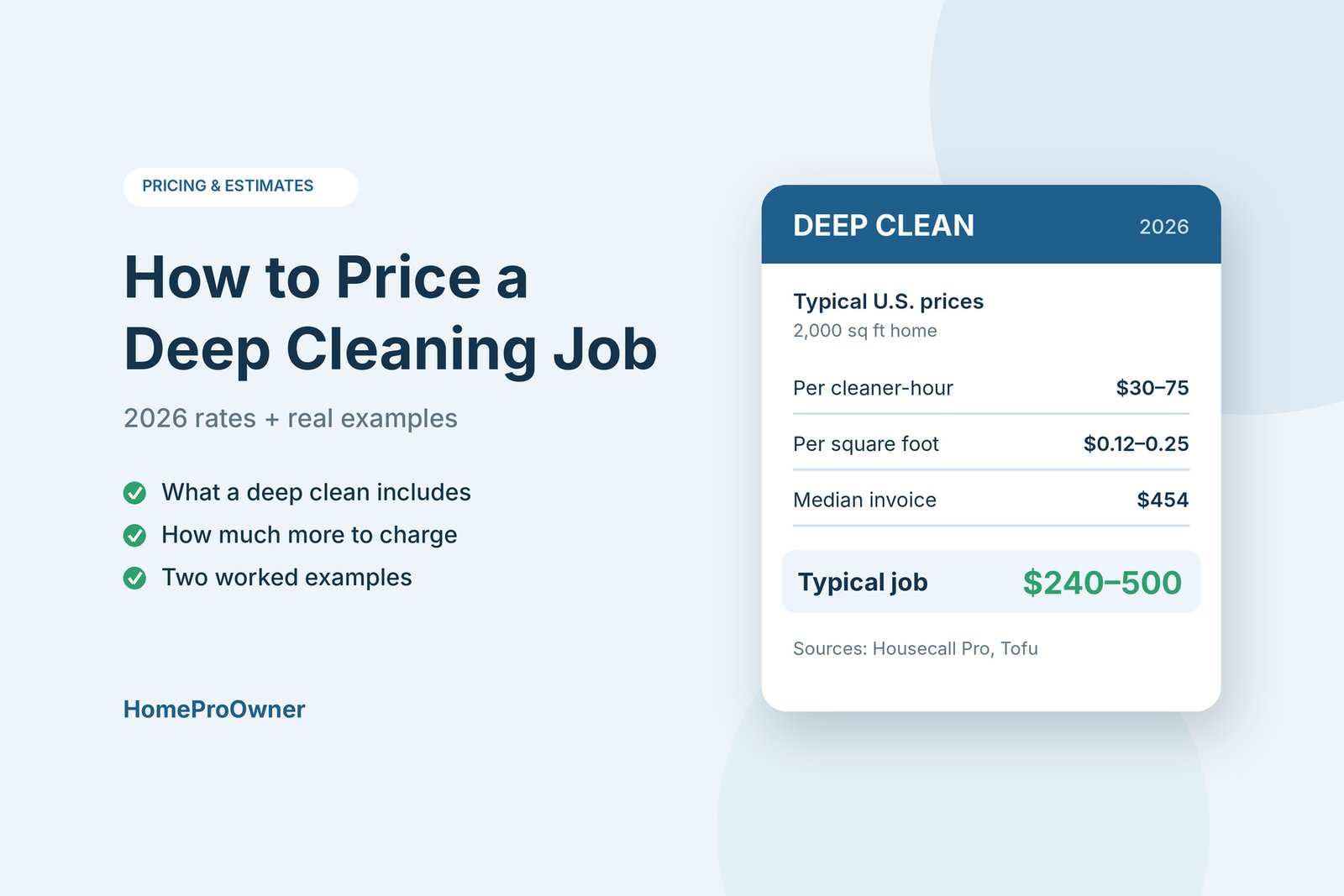
Here are typical U.S. deep cleaning prices, based on Housecall Pro’s 2026 pricing guide:
| Home size | Typical deep clean price |
|---|---|
| 1,000 sq ft or less | $120–$250 |
| 2,000 sq ft | $240–$500 |
| 3,000 sq ft | $360–$750 |
By other pricing methods, deep cleans typically run $30–$75 per cleaner-hour, or $0.12–$0.25 per square foot. Real invoice data points in the same direction: an analysis by Tofu of more than 24,000 deep cleaning invoices found a median of $454, with most jobs falling between $304 and $722.
These ranges are wide on purpose. Your local market, your costs, and above all the condition of the home will decide where you land.
How much more should a deep clean cost than a regular clean?
This is where things get confusing, because the most-cited sources disagree:
- Housecall Pro says deep cleaning typically costs 50% to 100% more than a standard clean.
- InvoiceFly recommends adding 30% to 50% to your normal rates.
- Tofu’s invoice data shows that, in practice, deep cleans end up only about 15% to 20% more expensive than regular cleans.
So who’s right? In a way, all of them, because they’re measuring different things. Percentage rules of thumb describe how much extra work a deep clean usually involves. Invoice data reflects what businesses actually manage to charge, and many of them, especially new ones, charge too little for deep cleans and absorb the extra hours themselves.
The safest approach is not to pick a percentage at all. Instead, estimate the real time the job will take and charge your normal hourly rate for every hour. A lightly used home might only need 20% more time than a regular clean. A home that hasn’t been cleaned properly in a year can easily need double. Pricing by time, not by percentage, covers both.
How to price a deep clean, step by step
1. Ask the right questions before you quote. When was the home last professionally cleaned? Are there pets? Any areas with heavy buildup, like the oven, the shower or the kitchen cabinets? Is the home furnished, and how cluttered is it? Ask for a few photos of the kitchen and bathrooms. They tell you more than any description.
2. Rate the condition. Put the home into one of three groups: light (well maintained), average, or heavy (months of buildup, pet hair, grease). This single judgment moves the price more than anything else.
3. Estimate the cleaner-hours. A useful starting point is that one cleaner covers around 300 square feet per hour on a deep clean, compared with about 500 on a standard clean. Add time for each extra bathroom, then adjust for condition and pets. Over time, replace these numbers with your own data from past jobs.
4. Multiply by your hourly rate. Use the same rate you use for every other job. The deep clean pays more because it takes more hours, not because you charge more per hour.
5. Price extras separately. Inside the oven, inside the fridge, inside cabinets and interior windows should be line items, not “included.” It keeps your base price competitive and lets the client choose.
6. Check the result against the market. Divide your total by the square footage. If you’re well below $0.12 or well above $0.25 per square foot, double-check your time estimate. Being above the range can be perfectly fine for a heavy job, as long as you can explain why.
7. Protect yourself with clear terms. State in your estimate that the price is based on the photos and information provided, and that it may be adjusted if the condition is significantly different on arrival.
Two real examples
Both examples use a rate of $50 per cleaner-hour. You can reproduce them with our free cleaning estimate calculator.
Example 1: a well-kept apartment
1,200 sq ft, 2 bedrooms, 1 bathroom, average condition, no pets. The client wants the fridge cleaned inside.
| Item | Price |
|---|---|
| Deep clean, all rooms (4 cleaner-hours at $50/hour) | $200 |
| Inside fridge | $35 |
| Total | $235 |
That works out to about $0.20 per square foot, right in the middle of the typical range.
Example 2: a family home with heavy buildup
2,500 sq ft, 4 bedrooms, 3 bathrooms, heavy buildup, two dogs. The client wants the oven and fridge cleaned inside.
| Item | Price |
|---|---|
| Deep clean, all rooms (about 13.6 cleaner-hours at $50/hour) | $680 |
| Inside oven | $35 |
| Inside fridge | $35 |
| Total | $750 |
That’s about $0.30 per square foot, above the usual range. But it’s justified: heavy buildup and pet hair add almost 45% to the time. With a team of two cleaners, it’s roughly a 7-hour job on site. If you had priced this home at a flat “regular price plus 20%,” you would have lost several hours of paid work.
Use the deep clean to win a recurring client
A deep clean is often the first job you do for a new client, and it’s the perfect moment to offer recurring service. Once the home has been reset, regular visits are much faster.
For the home in Example 2, a biweekly standard clean after the deep clean would take around 6.4 cleaner-hours, or about $320 per visit. The client sees a clear reason to keep you, and you get predictable income from a home you already know.
Common mistakes when pricing deep cleans
- Quoting a deep clean like a regular clean with a small markup. Price the hours, not a percentage.
- Quoting without photos or a walkthrough. Condition is the biggest variable, and you can’t judge it over the phone.
- Including every extra for free. Ovens, fridges and cabinets can each add 30 to 60 minutes.
- Forgetting the team size. Two cleaners finish faster, but the client still pays for every cleaner-hour.
- Not writing down what’s included. A clear checklist prevents disputes.
Frequently asked questions
How long does a deep clean take?
It depends on size and condition. As a rough guide, one cleaner covers around 300 square feet per hour, so a 2,000 sq ft home in average condition takes about 7 to 8 cleaner-hours, or 3.5 to 4 hours on site with a team of two.
Should I charge a flat rate or by the hour for deep cleans?
For first-time deep cleans, base your price on estimated hours, then present it to the client as a fixed price. Clients prefer knowing the total in advance, and you’re protected because the estimate came from real time.
Should the first clean for a new client always be a deep clean?
In most cases, yes. If the home hasn’t been professionally cleaned in a while, a standard clean won’t bring it to the level you’ll be maintaining, and the client will judge you on the result.
Do I need to charge more for move-out deep cleans?
Usually yes. Move-out cleans tend to include inside cabinets and appliances, and landlords expect a higher standard. Price them as a deep clean with those extras included.