
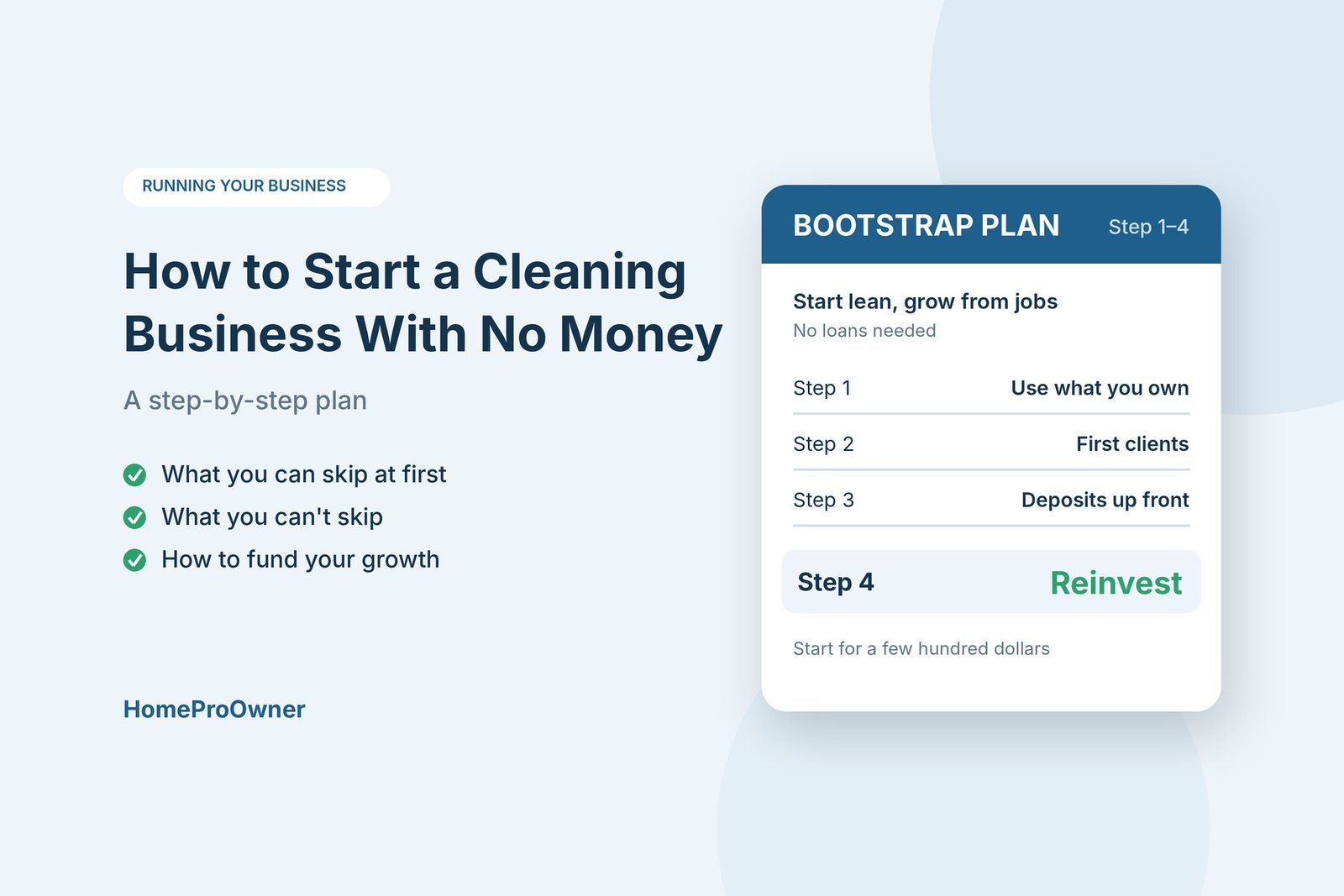
You don’t need savings or a loan to start a cleaning business. Many successful cleaning companies began with one person, the supplies under their kitchen sink and a few friends willing to give them a chance. The secret is to start small, spend only on what your first jobs need, and let your early clients pay for everything else.
This guide shows you how to start a cleaning business with little or no money, what you can safely skip at the beginning, what you can’t skip, and how to fund your growth from your first jobs.
Is it really possible to start with no money?
Almost. You can start with very little, but not with absolutely nothing. You’ll need some basic supplies, a way to get to clients, and, before long, insurance and a business license. The good news is that most of these costs can be covered by your first few jobs.
According to Tofu, a solo residential cleaning business can launch for as little as about $300. For a full breakdown, see our guide on how much it costs to start a cleaning business.
Step 1: Start solo and residential
Commercial cleaning needs bigger equipment, higher insurance limits and often a team. Residential cleaning is the cheapest way to start: just you, your supplies and your car. No payroll, no second vehicle, no large contracts to fund.
Step 2: Use what you already own
Look around your home. You probably already have a vacuum, a mop, a bucket, cloths and some cleaning products. Use them for your first jobs. If you need to buy anything, buy only what the first job requires:
- All-purpose cleaner, glass cleaner and disinfectant
- Bathroom cleaner and a degreaser for kitchens
- A pack of microfiber cloths
- Scrub brushes, sponges and gloves
- A caddy to carry everything
A basic kit like this often costs around $100 to $200 if you’re starting from zero.
Step 3: Keep the paperwork simple, but legal
Many cleaners start as sole proprietors, which keeps registration costs low. You can form an LLC later, once you’re earning. What you shouldn’t skip:
- A business license, if your city or county requires one. Check before your first paid job.
- Liability insurance, before you work in clients’ homes. Paying monthly, often around $54 to $75 per month according to Housecall Pro, keeps your upfront cost low.
Requirements vary by state and city, so check locally, and consider asking an accountant how to set up your business.
Step 4: Get your first clients for free
You don’t need a marketing budget. Start with:
- Your network: message friends, family and neighbors one by one.
- A Google Business Profile: free, and one of the best ways for local clients to find you.
- Local groups: Nextdoor and neighborhood Facebook groups.
Our guide on how to get your first cleaning clients includes message scripts and a 30-day plan.
Step 5: Price your work properly from day one
When money is tight, it’s tempting to charge very little to win jobs. Don’t. Underpricing means you work hard and still can’t afford supplies, insurance or gas. Price based on the real time each job takes, and include your costs. Our cleaning estimate guide and calculator will help you set fair prices.
Step 6: Get paid on time, and ask for deposits
Cash flow matters more than anything when you start with no money:
- Get paid on the day of the clean, by card or bank transfer.
- Ask for a deposit on larger jobs, like deep cleans and move-out cleans. A 25% to 50% deposit can cover any extra supplies the job needs.
- Put your terms in writing, including your cancellation policy.
Step 7: Reinvest your first earnings
Your first paychecks are your startup capital. Reinvest them in this order:
- Insurance, if you don’t have it yet.
- A better vacuum, your most important tool.
- A full supply kit, so you never run out mid-job.
- Simple marketing: business cards, flyers and photos for your Google profile.
- Scheduling and invoicing software, once managing clients by hand gets messy.
And set money aside for taxes from every payment. Many new business owners are surprised by their first tax bill. An accountant can tell you how much to save.
A simple 90-day plan
| Period | Focus | Goal |
|---|---|---|
| Days 1–30 | Network, first clients, basic supplies | First 3 to 5 paying jobs |
| Days 31–60 | License, insurance, Google profile, reviews | First recurring clients |
| Days 61–90 | Reinvest in equipment and marketing | A steady weekly schedule |
Common mistakes to avoid
- Buying equipment you don’t need yet. Buy for the jobs you have.
- Charging too little to win clients. It leaves you with no money to grow.
- Working without insurance. One accident can cost far more than a year of premiums.
- Spending everything you earn. Reinvest and save for taxes.
- Waiting until everything is perfect. Your first client matters more than your logo.
Frequently asked questions
Can I really start a cleaning business with no money?
You can start with very little. With the supplies you already own, free marketing and your first jobs paying for insurance and equipment, many people start with just a few hundred dollars.
Do I need an LLC to start a cleaning business?
Not necessarily. Many cleaners start as sole proprietors and form an LLC later. Check your state’s rules and consider professional advice.
What supplies do I need for my first cleaning job?
All-purpose cleaner, glass cleaner, disinfectant, bathroom cleaner, a degreaser, microfiber cloths, scrub brushes, gloves, a vacuum and a mop.
How fast can a cleaning business make money?
Very fast compared with most businesses. Because startup costs are low, many cleaners cover their startup costs within their first few jobs.