
A good cleaning estimate does two jobs at once: it tells the client exactly what they’re paying for, and it protects you from doing three hours of extra work for free. Get it wrong and you either lose the job because your price looks random, or win it and lose money on it.
In this guide, you’ll learn what to include in a cleaning estimate, how to calculate a fair price, and how to put it all together, with a real example and a free calculator you can use right now.
What to include in a cleaning estimate
Every cleaning estimate should answer the client’s questions before they ask them. At a minimum, include:
- Your business details: name, phone, email, and logo if you have one.
- Client details: name, address of the property, and contact information.
- Date and estimate number: so you can track it and refer back to it.
- Type of cleaning: standard, deep, move-out, or post-construction.
- Scope of work: a clear list of rooms and tasks included.
- Extras: anything outside the standard scope, like the inside of the fridge or oven, priced separately.
- Total price: with a breakdown, not just one number.
- Terms: payment method, cancellation policy, and what happens if the home is in worse condition than expected.
- Expiration date: most estimates are valid for 14 to 30 days.
The scope of work is the most important part. “Clean the kitchen” can mean wiping counters or degreasing every cabinet. Spell it out.
How to calculate the price
There are three common ways to price a cleaning job, and most successful businesses use more than one.
Hourly pricing. You estimate how many cleaner-hours the job takes and multiply by your hourly rate. In the U.S., most cleaning businesses charge between $30 and $75 per cleaner per hour in 2026, according to Housecall Pro’s 2026 pricing guide. Hourly pricing works well for first visits and homes you’ve never seen.
Per-square-foot pricing. You charge a rate based on the home’s size, usually somewhere between $0.10 and $0.35 per square foot depending on the type of cleaning. It’s simple and works well for large or empty homes, but it ignores clutter and condition, so always pair it with a walkthrough.
Flat-rate pricing. You charge a fixed price per visit. Clients love it because they know the number in advance. The smart move is to start with hourly or square-foot pricing for the first visit, then switch recurring clients to a flat rate once you know how long the job really takes.
What makes the price go up or down:
- Size of the home and number of bathrooms (bathrooms take the most time).
- Condition: a home with months of buildup can take 30% longer or more.
- Pets: pet hair adds time to every room.
- Type of clean: deep cleans typically cost 50% to 100% more than standard cleans.
- Frequency: weekly and biweekly clients usually get a lower per-visit price, because the home stays cleaner.
For reference, an analysis of more than 214,000 real cleaning invoices by Tofu found a median price of $385 for a residential cleaning job in 2026, $454 for a deep clean, and $347 for a move-out clean. Your local market may be higher or lower, but these numbers are a useful reality check.
One small business owner I work with told me his biggest mistake early on wasn’t the number itself. It was overcomplicating the price, both when he calculated it and when he talked about it with clients. Looking back, he realized the problem was that he didn’t truly see the value of what he was offering, so he hesitated, over-explained, and second-guessed every quote. That pushed him to rethink his value proposition. Since then, he follows a simple rule: whenever a price feels “too high” to him, he takes it as a sign that he’s undervaluing his work, and he adds 10%.
Try it: cleaning estimate calculator
Use the calculator below to get a starting price for any job. Change the hourly rate to match your area and your costs.
Cleaning Estimate Calculator
Enter the job details to get a starting price range for your estimate. Adjust the hourly rate to match your local market.
This calculator gives a starting point, not a final quote. Real prices depend on your area, your costs and what you see during the walkthrough. Always confirm the scope with the client before sending the estimate.
Step-by-step: how to write the estimate
1. Ask the right questions first. Before you price anything, find out the size of the home, the number of bedrooms and bathrooms, whether there are pets, when it was last professionally cleaned, and what the client cares about most.
2. Do a walkthrough when you can. A quick visit or video call shows you things the client won’t mention: clutter, stains, buildup, or a kitchen that hasn’t been degreased in years. For first-time deep cleans and move-outs, a walkthrough is almost always worth it.
3. Estimate the time. Use your own past jobs if you have them. If you’re new, a rough starting point is that one cleaner covers around 500 square feet per hour on a standard clean, and closer to 300 on a deep clean. Then adjust for bathrooms, condition, and pets.
4. Calculate the price. Multiply cleaner-hours by your hourly rate, then add extras. Check the result against the per-square-foot range to make sure it isn’t way off.
5. Write the scope clearly. List every room and task. Add a line for what is not included, like inside the oven or exterior windows. This one line prevents most disagreements.
6. Add your terms and send it fast. Include payment terms, your cancellation policy, and an expiration date. Send it the same day if you can; the first professional estimate a client receives often wins the job.
7. Follow up. If you don’t hear back in two or three days, send a short, friendly message. Many clients simply forget.
Example cleaning estimate
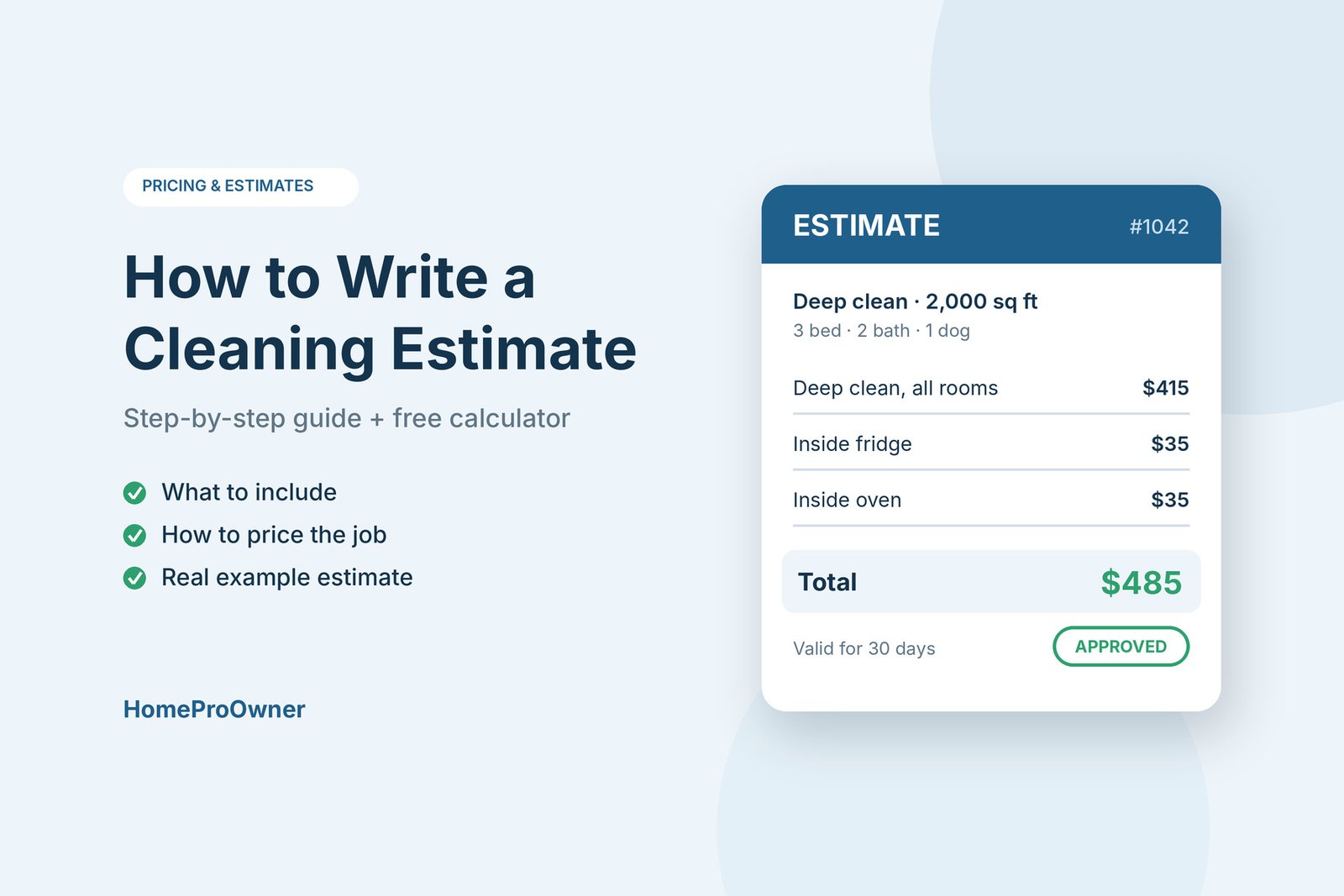
Here’s what a real estimate might look like for a first-time deep clean:
Client: Sarah Johnson, 2,000 sq ft home, 3 bedrooms, 2 bathrooms, one dog
Type of cleaning: Deep clean (first visit)
| Item | Price |
|---|---|
| Deep clean, all rooms (8.3 cleaner-hours at $50/hour) | $415 |
| Inside fridge | $35 |
| Inside oven | $35 |
| Total | $485 |
Included: dusting all reachable surfaces, baseboards, ceiling fans and light fixtures, kitchen cabinets wiped outside, appliances cleaned outside, bathrooms fully scrubbed and descaled, floors vacuumed and mopped, trash removed.
Not included: exterior windows, carpet shampooing, inside cabinets.
Terms: payment due on completion by card or bank transfer. Cancellations with less than 24 hours’ notice are charged 50%. If the home’s condition is significantly different from what was described, the price may be adjusted before work begins.
Valid until: 30 days from the estimate date.
Free cleaning estimate template
Want to skip the blank page? Download this free one-page template with everything covered in this guide: client details, job details, scope of work, pricing table, terms, and a signature section. Just replace the text in brackets with your own information.
Common mistakes to avoid
- Pricing without seeing the home. Photos or a video call are the minimum for deep cleans.
- Forgetting travel time and supplies. Your hourly rate has to cover them.
- Writing a vague scope. “Full clean” means something different to every client.
- Racing to be the cheapest. Low prices attract difficult clients and leave no room for mistakes.
- Not putting it in writing. A verbal quote is easy to forget and easy to dispute.
- Ignoring the work you won’t get paid for. Several business owners I’ve spoken with agree on this one: a lot of the work behind every job is unpaid. Walkthroughs, phone calls, travel, writing the estimate itself, and following up all take time, and if your price doesn’t account for them, you’re working for free without realizing it. That’s why a careful estimate matters so much: the money you lose by rushing an estimate today doesn’t disappear, it shows up later as jobs that take longer than you charged for.
Frequently asked questions
How much should I charge for my first cleaning jobs?
Start near the middle of your local market, not the bottom. Check what other cleaners in your area charge, and use the calculator above as a starting point.
Should I charge by the hour or a flat rate?
Use hourly or per-square-foot pricing for first visits, then move recurring clients to a flat rate once you know the job.
How long should a cleaning estimate be valid?
Between 14 and 30 days is standard. After that, prices and the condition of the home can change.
Do I need to visit the home before giving an estimate?
Not always for standard cleans, but for deep cleans, move-outs, and post-construction jobs, a walkthrough or video call protects you from underpricing.